
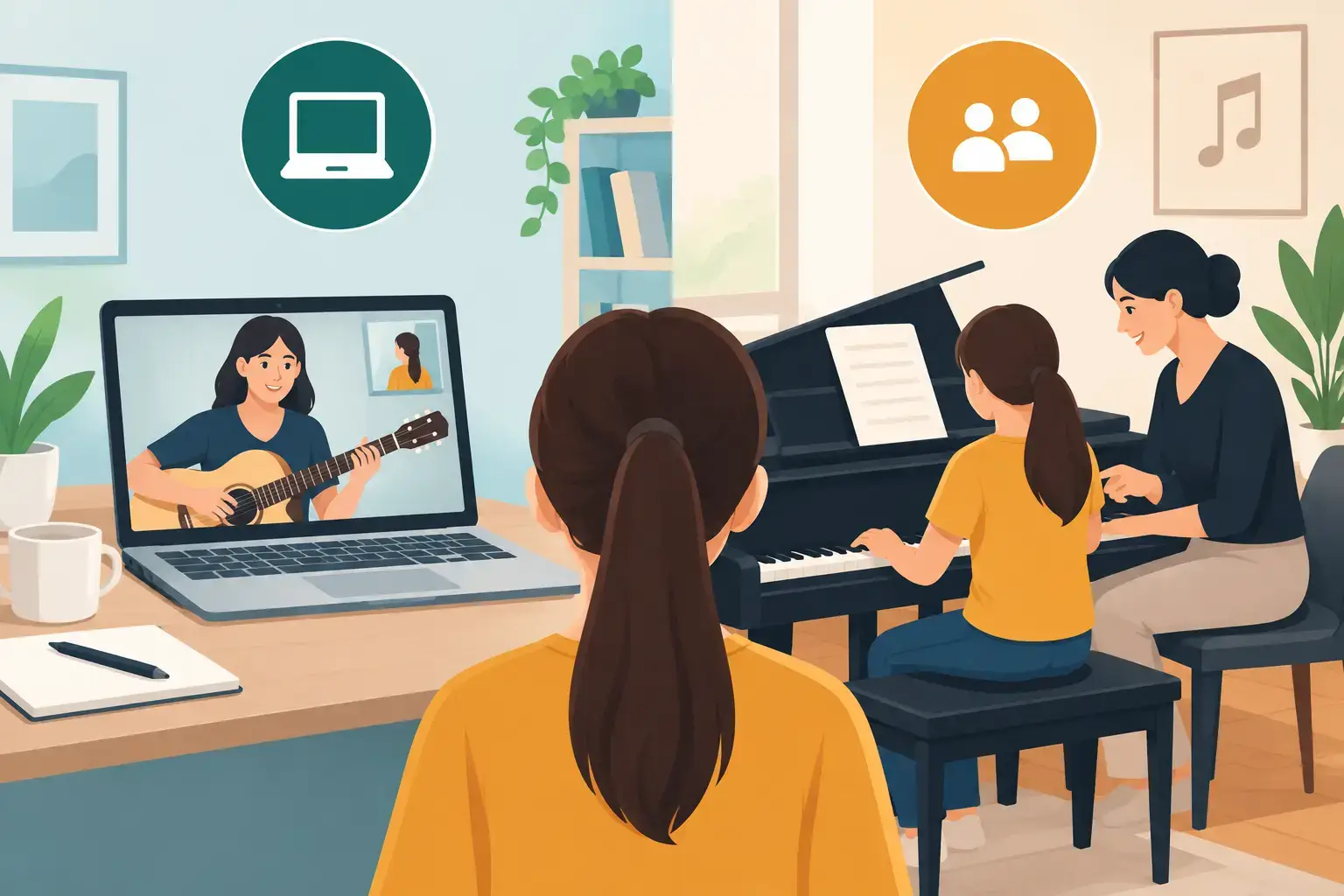
A child finally plays the first song they have been practicing all week. An adult returns to the piano after years away and realizes, “I can do this.” Those moments matter more than the screen or the room where they happen. When families compare online lessons vs in person music lessons, the best choice is the one that helps the student stay excited, make steady progress, and feel supported enough to keep going.
Both formats can build real musical skill. The difference is in the experience: how easily a student focuses, how quickly an instructor can respond, how much convenience the family needs, and whether performance and musical community are part of the goal.
Online Lessons vs In Person: What Changes?
Online music lessons bring the teacher into your home. With a reliable device, a decent internet connection, and a space where the student can hear and be heard, lessons can be personal, structured, and surprisingly productive. This format is especially helpful for busy families, adult students with full schedules, and students who do better learning in a familiar environment.
In-person lessons create a different kind of momentum. The student walks into a space designed for music, away from homework, chores, pets, and the temptation to check another tab. An instructor can demonstrate technique from several angles, make hands-on adjustments when appropriate, and respond to details that are harder to catch through a camera.
Neither choice is automatically better. A motivated teen with a quiet home setup may thrive online. A young beginner who needs frequent encouragement and help with posture may grow faster in person. The question is not which format is more modern. It is which one gives your musician the best chance to enjoy the process and reach their goals.
When Online Music Lessons Make Sense
Online lessons can be a great fit when consistency is the biggest challenge. If travel time makes it hard to protect a weekly lesson, learning from home can remove a major obstacle. Instead of rushing across town after school or work, the student can set up their instrument and be ready to play.
This convenience can be especially valuable for adult beginners and returning musicians. Adults often have complicated calendars, but they still deserve a creative outlet that belongs to them. An online piano, guitar, voice, or songwriting lesson can make it easier to keep that commitment without adding another long drive to the week.
Online instruction also encourages students to become comfortable with their own practice setup. They learn how to position their music, adjust their instrument, hear their sound in their actual room, and build independent practice habits. That is a meaningful skill. After all, most practice happens at home, not in a lesson studio.
For students interested in music production, online learning can be particularly practical. They can work directly in the software, recording setup, and headphones they use between lessons. The instructor can guide workflow, troubleshoot techniques, and help turn a musical idea into a finished track in the same environment where the student will continue creating.
Still, online lessons work best when the student has a dependable routine. A stable internet connection helps, but attention matters even more. Younger students may need a parent nearby to assist with setup, keep the lesson moving, and celebrate small wins.
Why In-Person Lessons Often Build Confidence Faster
Music is physical. A guitarist needs to see how relaxed hands feel. A drummer needs to understand stick control and timing. A singer benefits from learning how posture and breath support affect tone. A pianist can make faster adjustments when an instructor can clearly see the bench height, wrist position, finger shape, and movement across the keys.
That immediate feedback is one of the strongest advantages of in-person lessons. Rather than trying to describe a tiny adjustment through a webcam, the instructor can demonstrate it, listen closely, and help the student try it again right away. For beginners, those small corrections can prevent frustrating habits from becoming permanent.
In-person lessons also provide a dedicated place to be a musician. Students often arrive a little nervous, then leave proud because they played something new, solved a problem, or performed a favorite song for someone who was fully paying attention. That focused time sends a powerful message: your goals are worth showing up for.
For children and teens, the relationship with a kind, encouraging instructor can be just as important as the technical instruction. A great teacher knows when to challenge a student, when to simplify a goal, and when to say, “You are closer than you think.” That encouragement builds confidence that reaches beyond music.
Performance and Community Are Easier to Experience in Person
If your goal is simply to learn a few songs for yourself, online lessons may provide everything you need. But if you want your child to gain confidence onstage, play with other musicians, or share their gifts with an audience, in-person instruction offers a fuller path.
Performing is a skill, not a personality trait. Students become more comfortable by having supportive chances to play for others: a small studio event, an open mic, a jam session, a band rehearsal, or a larger venue performance. These experiences teach preparation, recovery, teamwork, and the joy of hearing applause after hard work.
At Matt Burk Music Studio, lessons can lead beyond the teaching room through community events, band experiences, masterclasses, and performance opportunities at respected local venues. For a student who dreams of joining a band, singing on a real stage, or simply feeling brave enough to play for grandparents, that bigger musical community can make all the difference.
Online students can perform too, of course. They can record videos, share songs with family, or join virtual events when available. But for many students, standing beside other musicians and feeling the energy of a live room is an experience that cannot be fully recreated on a screen.
Consider the Student, Not Just the Schedule
Before choosing a format, think about how your student learns. Do they stay focused at home, or do they associate home with relaxing and distractions? Do they need visual demonstrations close up? Are they excited by meeting other musicians? Is transportation difficult? Does a parent need a flexible option that keeps one more activity manageable?
Age matters, too. Many younger beginners benefit from in-person lessons because the instructor can keep the energy high and guide the physical basics more easily. Older teens and adults may be more capable of managing an online lesson independently, especially when convenience helps them stay consistent.
The instrument matters as well. Voice, piano, guitar, bass, ukulele, and music production can all work online with the right setup. Drums and certain ensemble-focused goals may benefit more from an in-person environment where sound, timing, equipment, and body mechanics are easier to evaluate.
Most importantly, consider motivation. The perfect format on paper is not helpful if the student dreads it. A student who looks forward to lessons is more likely to practice, take healthy risks, and keep building skills through the inevitable hard parts.
You Do Not Have to Choose Forever
One of the best parts of personalized music education is flexibility. A family may start with online lessons during a busy season, then move to in-person lessons when a student is ready for more performance opportunities. An adult may prefer online sessions most weeks but choose in-person coaching before an audition or special event.
Progress does not require a rigid, one-size-fits-all plan. It requires a clear goal, a caring instructor, regular effort, and lessons that make the student want to return next week. Whether that happens through a screen or across a music room, the right teaching relationship can turn “I wish I could play” into “Listen to what I learned.”
If you are still deciding, let the student try a lesson and pay attention to what happens afterward. Do they leave energized? Do they talk about the song they want to learn next? That excitement is worth following.