
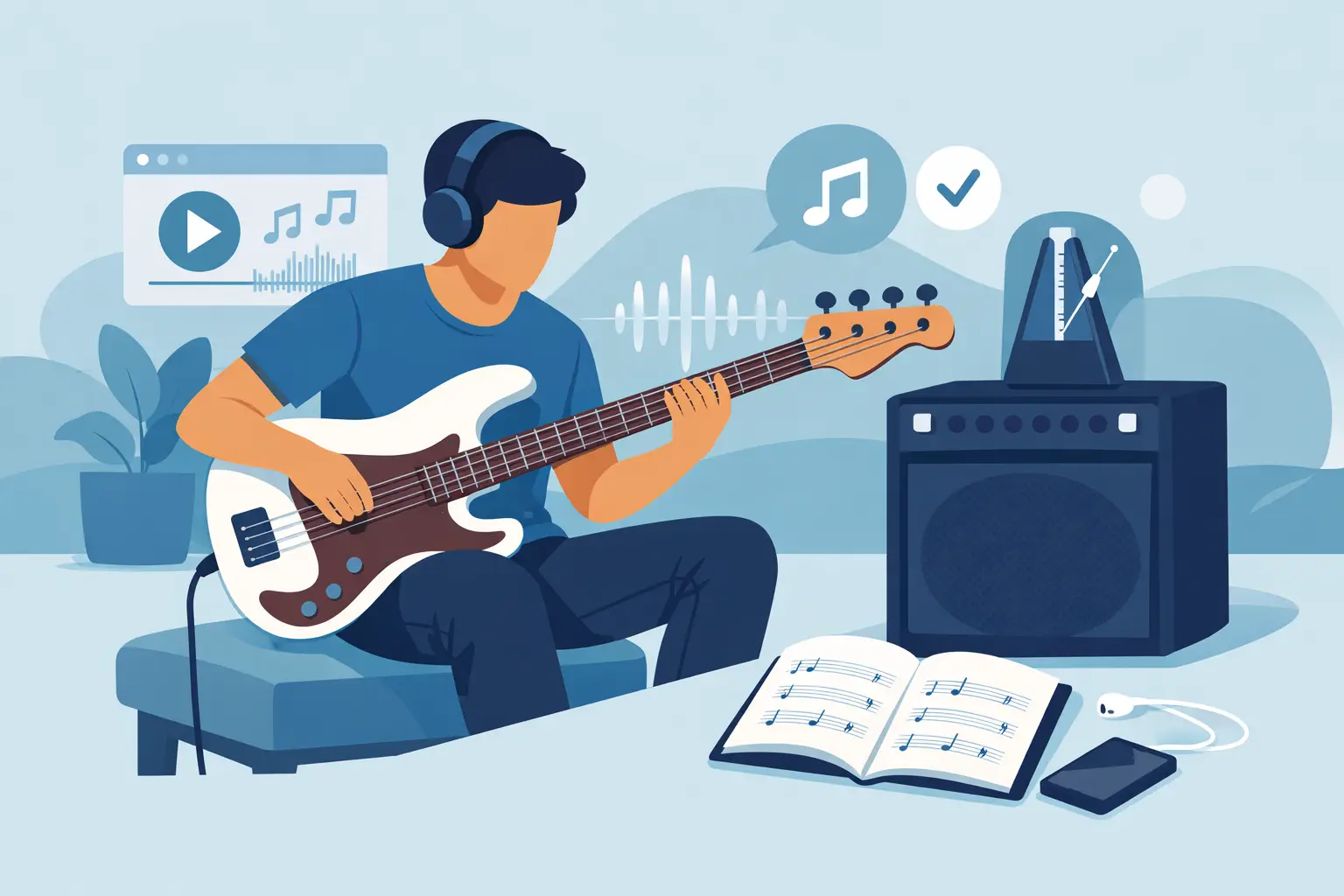
If you just got your first bass, it can be surprisingly hard to know what to do after the excitement wears off. A lot of beginners sit down, play a few random notes, maybe learn part of a riff, and then wonder why progress feels slow. A good beginner bass practice routine fixes that. It gives you a simple path so every practice session builds real skill, not just busy time.
The good news is you do not need to practice for hours a day to improve. You need consistency, a clear structure, and a routine that feels doable enough to repeat. That matters for kids, teens, and adults alike. When practice feels organized and encouraging, people stick with it longer, and that is when confidence starts to grow.
Why a beginner bass practice routine matters
Bass is one of those instruments that sounds simple from the outside and feels very different once you start playing. You are not just learning where the notes are. You are learning how to keep steady time, how to make each note sound clean, how to lock in with a groove, and how to support music without overplaying.
That is exactly why random practice tends to stall out. If you only play songs, your technique may stay shaky. If you only run exercises, you may get bored fast. The best beginner bass practice routine balances both. It helps you build the mechanics and the musical side at the same time.
There is also a practical reason for structure. Beginners often improve in uneven bursts. One week your fingers feel stronger, and the next week your timing falls apart. That does not mean you are failing. It usually means your ears are getting sharper. A routine helps you keep moving through that awkward middle stage instead of quitting there.
A simple 30-minute bass practice plan
For most beginners, 30 minutes is a strong starting point. It is long enough to make progress and short enough to fit into real life. If you only have 15 minutes, you can cut each section down. If you have 45, you can spend a little more time on songs or groove work.
1. Warm up for 5 minutes
Start by getting your hands comfortable. Play slow notes on each string. Focus on relaxed shoulders, curved fingers, and clean sound. You do not need anything fancy here. Even a basic one-finger-per-fret exercise can help wake up both hands.
The point of a warm-up is not speed. It is control. If your notes are buzzing, muted, or uneven, slow down and fix that first. Bass rewards solid fundamentals, and a calm start usually leads to a better session.
2. Work on technique for 10 minutes
This is where you build the habits that make everything else easier. Practice fretting cleanly, alternating your plucking fingers, and keeping your thumb and wrist in a comfortable position. Early on, simple exercises are enough.
You might play a short pattern up and down the neck or move between two strings while keeping the rhythm steady. The goal is to make your playing feel smooth and controlled. Fast playing can come later. Clean playing comes first.
If you are a younger student, it helps to keep technique work short and focused so it does not feel repetitive. Adult beginners often do better when they know exactly what they are listening for, like even volume or reduced finger tension. Either way, the win is quality, not quantity.
3. Practice rhythm and timing for 5 to 10 minutes
Bass players live in the rhythm section. Even at the beginner level, timing matters just as much as note choice. Practicing with a metronome or a basic drum beat is one of the best things you can do.
Start with quarter notes on one pitch. Then try eighth notes. Count out loud if needed. It may feel awkward at first, but that is normal. Counting helps connect your hands to the beat instead of guessing your way through it.
A lot of beginners want to skip this part because it is less flashy than learning songs. That is understandable, but timing is what makes a bass player feel good to play with. If your groove is steady, even simple lines sound musical.
4. Learn music for 10 minutes
This is the fun part, and it should stay in your routine. Work on a riff, a bass line, or a section of a song you enjoy. Choose music that is just challenging enough to stretch you without making you feel stuck the entire time.
If a song is too hard, break it into tiny sections. One measure at a time is completely fine. Slow it down. Say the fret numbers out loud. Repeat small chunks until they feel comfortable, then connect them.
This is also where motivation grows. When beginners can hear themselves playing real music, practice starts to feel rewarding. That sense of progress matters, especially for students who need a confidence boost early on.
What to practice during your first few months
A beginner does not need an endless list of exercises. In fact, too much material can make practice feel scattered. A better approach is to focus on a few core skills and revisit them often.
During the first few months, most bass students should spend time on hand position, plucking consistently with index and middle fingers, fretting notes cleanly without excess pressure, reading basic rhythm patterns, and learning note names on the lower frets. Simple major scales and basic groove patterns can also be helpful once the basics start settling in.
It depends a little on age and goals. A child may need shorter activities and more variety. A teen who wants to join a band may need extra rhythm training. An adult beginner may want a routine that feels practical and stress-free after work. The best plan is one that matches the player, not one that looks impressive on paper.
How often should beginners practice bass?
For most new players, four to six short sessions per week works better than one long weekend session. Consistency builds muscle memory. Your fingers, ears, and timing all improve faster when they get regular repetition.
That said, there is a trade-off. Daily practice is great, but only if it stays positive and sustainable. If seven days a week turns practice into a battle, scale it back. A routine that actually happens is always better than a perfect schedule that gets abandoned.
Parents sometimes worry that shorter practice means slower progress. Usually, the opposite is true. Shorter sessions often lead to better focus, especially for younger students. Adults benefit too. Twenty focused minutes can beat an hour of distracted playing.
Common mistakes in a beginner bass practice routine
One common mistake is rushing. Beginners often think progress should look fast, but bass is built on precision. If you move too quickly, sloppy technique can settle in and become harder to fix later.
Another mistake is only practicing what already feels easy. It is natural to repeat the riff you like most, but growth usually happens just outside that comfort zone. A good routine includes something familiar, something challenging, and something fun.
The third big issue is playing without listening. Bass is a listening instrument. Pay attention to note length, tone, timing, and whether your sound matches what you meant to play. If you can hear the difference between okay and clean, your improvement speeds up.
How lessons can make your routine work better
A practice routine is powerful, but it becomes even more effective when someone helps you tailor it. That is especially true for beginners who are not yet sure what to fix on their own. A teacher can spot tension, timing issues, or hand position problems before they turn into bigger obstacles.
Just as important, lessons can keep practice encouraging. When students know what to work on and why it matters, they usually stay more motivated. That is a big reason personalized instruction helps beginners progress with less frustration. At Matt Burk Music Studio, that kind of student-first guidance is designed to help players build skill, confidence, and real enjoyment from the start.
A bass routine should help you feel successful
The best beginner bass practice routine is not the one with the most exercises. It is the one you can return to week after week and actually feel good about. Start simple. Keep your sessions focused. Let technique, rhythm, and music all have a place.
And give yourself room to grow. Every steady note, cleaner transition, and tighter groove counts. Stick with it, and the bass will start to feel less like a puzzle and more like your voice.