
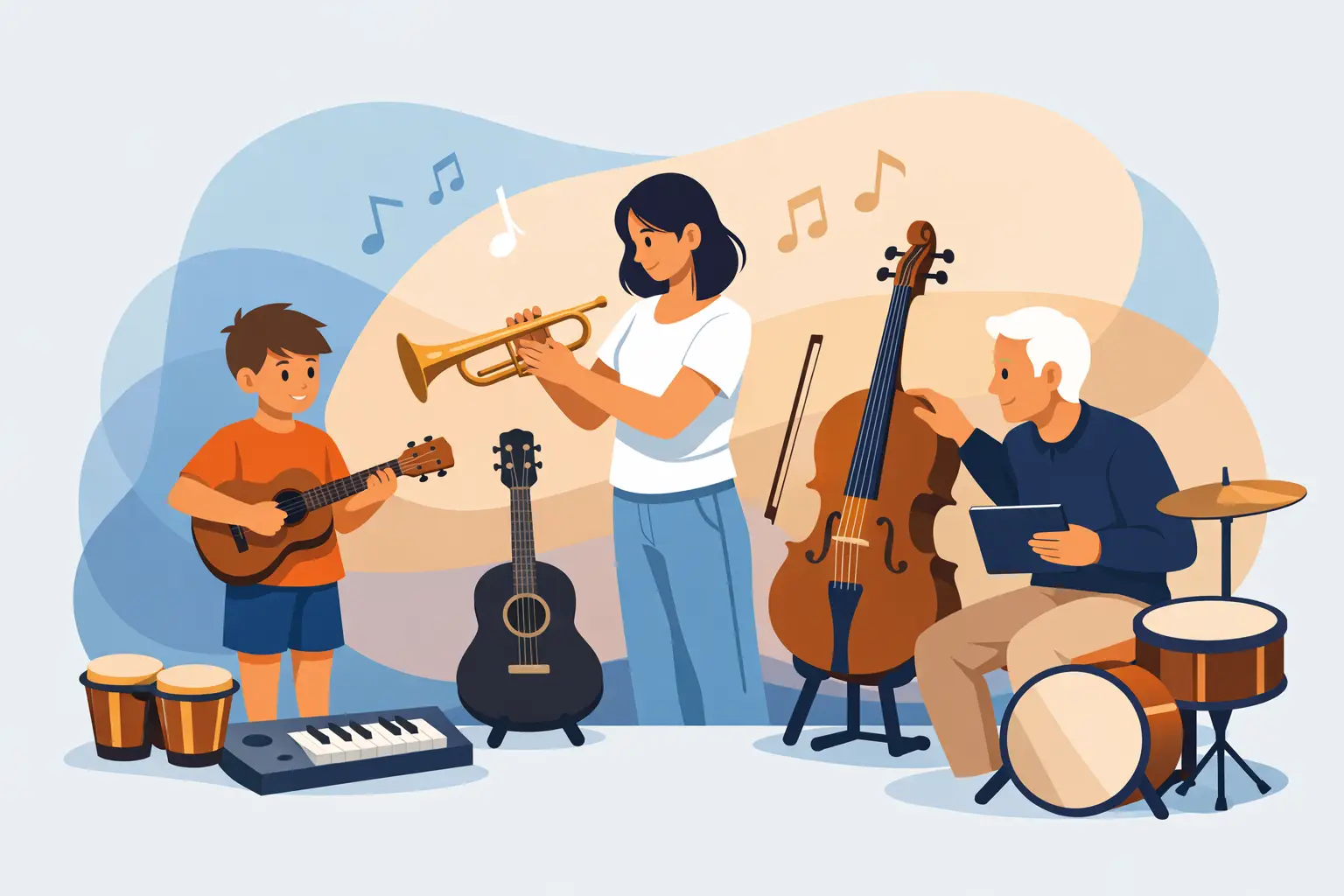
A child lights up at the drums, then asks about piano on the ride home. An adult has always wanted to sing, but keeps wondering if guitar would be more practical. If you're trying to figure out how to choose first instrument, you're not looking for a random guess. You want something that feels exciting now and still makes sense a few months from now.
That is the sweet spot.
The best first instrument is rarely the one that seems most impressive or most affordable on paper. It is the one that matches the student's personality, goals, attention span, and daily life well enough that they actually stick with it. Progress matters, but enjoyment matters first. When a student likes the sound they are making and feels early wins, practice stops feeling like a chore.
How to Choose First Instrument Without Overthinking It
Parents and beginners often assume there is one objectively correct starting point. Usually, there isn't. There are great beginner instruments, of course, but the right choice depends on who is learning.
A five-year-old with lots of energy may thrive on drums or piano because both offer immediate sound and movement. A teen who loves songwriting may connect faster with voice, piano, or guitar because those instruments support melody and chords early on. An adult beginner who wants a low-pressure hobby may enjoy ukulele because it feels approachable and rewarding from day one.
Instead of asking, "What is the best instrument?" ask a better question: "What instrument will keep this student motivated long enough to grow?" That shift makes the decision much easier.
Start With the Student, Not the Instrument
Before comparing options, think about what the student is naturally drawn to. If they already replay certain songs, mimic drum patterns on the table, or sing constantly around the house, that interest matters. Natural curiosity is a strong predictor of consistency.
Age matters too, but not in a rigid way. Younger children often do well with instruments that provide quick feedback and clear structure. Piano is a strong starting point because students can see the notes laid out in order, which helps many beginners understand music more easily. Drums can be excellent for students who need movement and physical engagement. Ukulele works well for many kids and adults because it is smaller, friendlier on the fingers, and easier to start strumming than guitar for some beginners.
For older students and adults, personal goals tend to matter even more than age. Someone who wants to play in a band may lean toward guitar, bass, drums, or voice. Someone who loves solo playing and broad musical foundations may be happiest with piano. Someone who wants to build confidence and express themselves may find voice lessons incredibly rewarding.
Interest Beats Tradition Almost Every Time
There is a common temptation to choose based on what seems most educational or respectable. Piano often gets picked for that reason, and piano is genuinely a fantastic first instrument. It builds note reading, coordination, rhythm, and a strong overall understanding of music.
But if the student really wants guitar, forcing piano first can backfire. The same goes for voice, drums, bass, or anything else. A student who feels ownership over the choice usually shows up with more energy. That energy turns into practice. Practice turns into growth.
The trade-off is that some instruments have a steeper early curve than others. Guitar can be tough on fingertips at first. Violin, while wonderful, demands strong pitch control early on. Drums require space and volume management. Voice can feel vulnerable because the instrument is your own body. None of those are reasons to avoid them. They are just part of making an informed choice.
Think About What Success Looks Like in the First 90 Days
One of the most useful ways to choose is to picture the first three months. What would feel exciting and realistic for this student?
If success means playing recognizable songs quickly, ukulele, piano, and drums often give satisfying early momentum. If success means singing with confidence in front of others, voice is the obvious fit. If success means joining friends and jamming, guitar and bass make a lot of sense.
This matters because beginners need small wins. They do not need a perfect five-year plan. They need to feel, early on, "I can do this. This is fun. I want to keep going." A good first instrument supports that feeling instead of delaying it.
Practical Questions That Really Matter
When families ask how to choose first instrument, practical concerns are usually right under the surface. That's not being less artistic. That's being realistic.
Budget matters. Some instruments are more affordable to start than others, both in the instrument itself and in maintenance. A beginner ukulele is usually less expensive than a quality drum setup. Keyboards can be a lower-cost way to begin piano before investing in a full acoustic instrument. Voice has no instrument purchase, but strong instruction still matters.
Space matters too. Drums are exciting, but they are not ideal for every apartment or busy household. Piano or keyboard needs a dedicated area. Guitar and ukulele are easier to store and carry. If getting the instrument out feels like a hassle every time, practice often drops.
Schedule matters as well. Students with packed weeks may do better on an instrument that makes short practice sessions feel productive. Piano, ukulele, voice, and guitar can all work beautifully here, but the teacher's approach is a big part of that success.
Personality Is a Bigger Factor Than Most People Expect
A shy student is not automatically better off avoiding voice or performance-based instruments. In many cases, voice lessons become the very thing that builds confidence. A high-energy student is not automatically "supposed" to play drums either. Some energetic students love the focus and pattern of piano.
Try to notice how the student engages. Do they enjoy structure, or do they learn best by experimenting? Do they like being center stage, or do they prefer a supporting role? Bass, for example, can be perfect for students who love groove and teamwork without always wanting the spotlight. Piano is great for students who like independence and a clear visual layout. Guitar often attracts students who want portability and song-based learning.
There is no personality test that gives a flawless answer. Still, paying attention to temperament can save a lot of frustration.
Try Before You Commit
If you can, let the student experience a lesson or brief introduction before making a long-term decision. This is one of the easiest ways to reduce pressure and avoid buying the wrong instrument too early.
Sometimes the answer becomes obvious once they actually try it. A student who thought they wanted drums may fall in love with piano after five minutes. Another may realize they do not just like singing along to songs - they truly want voice training and performance coaching.
This is where a student-centered lesson environment makes a huge difference. At Matt Burk Music Studio, many beginners start with a free trial lesson so they can get a feel for the instrument, the teacher, and the learning experience before committing. That kind of low-pressure first step helps families make a decision with confidence instead of crossing their fingers.
The Best Beginner Choices, Honestly
If you want a simple starting shortlist, piano, guitar, ukulele, voice, drums, and bass are all strong options for first-time students. Each can work extremely well when the fit is right.
Piano is one of the most versatile first instruments because it builds broad musicianship. Guitar is great for song lovers and future band players, though the beginning can be physically challenging. Ukulele is friendly, fun, and encouraging for many ages. Voice is deeply personal and powerful, especially for students who connect strongly to lyrics and performance. Drums can be a fantastic outlet for rhythm and energy. Bass is often overlooked, but it is an excellent path for students who want to play with others and feel the heartbeat of the music.
The wrong move is not choosing one of these. The wrong move is choosing based only on what someone else thinks a student should play.
If You're Still Torn Between Two Instruments
That is normal. In fact, it usually means you are asking good questions.
When two instruments both seem appealing, choose the one the student is more excited to touch this week, not the one that sounds slightly better in theory. You can always add or switch later. Music is not a one-chance decision. Many strong musicians start on one instrument and branch into others once they build confidence and momentum.
The first instrument does not have to be the forever instrument. It just needs to be the right instrument for now.
A Good First Choice Builds More Than Skill
When beginners feel supported, challenged at the right pace, and excited about what they are learning, they gain more than notes and technique. They build confidence. They discover discipline without dread. They start seeing themselves as musical people.
That identity shift is powerful, especially for kids and teens. It matters for adults too. Choosing an instrument is not just picking an object. It is choosing a path into creativity, self-expression, and growth.
So if you're trying to decide how to choose first instrument, keep it simple. Follow the student's interest, consider the realities of daily life, and look for an environment that makes learning feel encouraging and personal. The right first instrument is the one that gets someone started with joy - and makes them want to come back next week.