
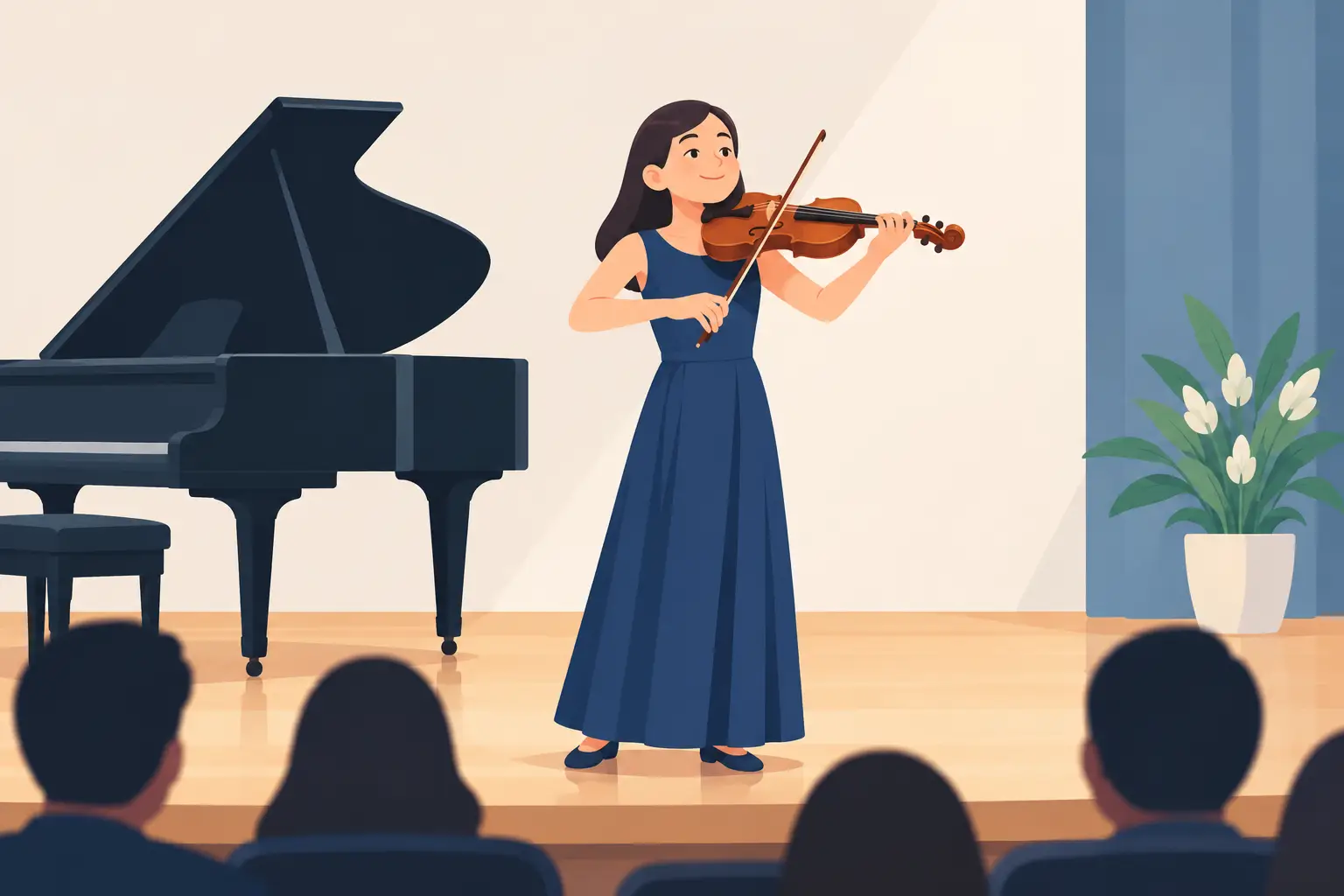
The moment before a recital performance can feel huge. A student may have played the same song beautifully at home all week, then suddenly worry about forgetting the first note when people are watching. This student recital confidence example shows what real progress can look like: not a musician who feels zero nerves, but one who knows what to do with them.
Imagine a 10-year-old piano student named Maya. At her first studio recital, she stands near the piano with her hands pressed together, quietly tells her teacher she is nervous, and wonders if everyone will notice a mistake. A few months later, after focused lessons and several low-pressure performance opportunities, Maya walks to the piano, takes a breath, adjusts the bench, and begins. She makes one small slip in the middle, keeps going, and finishes with a smile.
That is confidence. It is not perfection. It is the ability to share music anyway.
Why recital confidence matters beyond one song
A recital is a meaningful milestone because it gives students a chance to turn private practice into a shared experience. They learn that music is not only something to get right in a lesson room. It is something they can communicate, enjoy, and give to other people.
For children and teens, that lesson often carries into school presentations, sports, auditions, and social situations. For adults, performing can be a powerful way to move past the thought that they are "too old," "not ready," or only allowed to play when nobody is listening. Every successful performance, even a short one, builds evidence that growth is possible.
Of course, not every student should be pushed onto a large stage before they are ready. Confidence grows best when challenge and support rise together. A beginning guitarist playing eight measures for a parent needs a different next step than an experienced vocalist preparing for an open mic night.
A student recital confidence example, step by step
Maya did not become more confident because someone told her to "just relax." Her confidence came from a clear process that gave her skills she could rely on when the butterflies showed up.
1. She chose a song that fit her current level
The right recital song is not always the hardest song a student can technically play. It should have enough challenge to feel exciting, while still being secure enough to perform under pressure. Maya and her teacher selected a piece she enjoyed and could learn thoroughly in the weeks before the recital.
That choice matters. Students often lose confidence when a performance piece is too difficult or learned too late. A strong, musical version of a simpler piece will usually create a better experience than a complicated song held together by last-minute effort.
2. She practiced starting, not only playing through
At home, Maya had a habit many musicians share: if she made a mistake, she stopped and started from the beginning. That can make a song feel polished in practice while leaving a student unprepared for the reality of a live performance.
Her teacher helped her practice several different starting points - the beginning, the middle, the final section, and the measure after a tricky transition. She also practiced continuing after an error. This gave her a practical safety net. If something went wrong on stage, she would not feel like the whole song was lost.
Parents can reinforce this at home by occasionally asking, "Can I hear the ending?" or "Can you start at the second section?" It keeps practice useful without turning every session into a test.
3. She performed in small, friendly settings first
Before the recital, Maya played for her teacher, then for one family member, then for a few people at a casual studio event. Each performance was short and manageable. Nobody expected perfection, and each audience member was there to encourage her.
This kind of gradual exposure helps students learn that nerves are survivable. Their heart may beat faster. Their hands may feel different. But they can still play. Small performances create the bridge between the lesson room and a bigger audience.
At Matt Burk Music Studio, students can build that bridge through supportive performance opportunities, community events, jam sessions, and live venue experiences. The goal is not to rush anyone. The goal is to make performing a familiar part of musical growth.
4. She built a pre-performance routine
On recital day, Maya did not need a complicated ritual. She needed a simple routine she had already practiced. She rolled her shoulders, took one slow breath, placed her hands in her lap, and thought of the first measure instead of the entire song.
A routine gives the mind somewhere helpful to go when nerves start creating distractions. For singers, it might include relaxed breathing and a quiet first lyric. For drummers, it may be counting the opening groove internally. For guitarists, it could mean checking posture, hand position, and the first chord.
The best routine is personal and repeatable. It should help a student feel grounded, not add another list of things to remember.
What parents can say before a recital
The words adults use before a performance can either reduce pressure or accidentally add more of it. Even a loving reminder to "do your best" can feel heavy to a child who already believes the recital has to be flawless.
Try focusing on effort, preparation, and enjoyment. You might say, "I love hearing you play this song," "You have worked hard for this," or "If you make a mistake, keep going. I will be proud of you either way." These messages tell students that the performance is an opportunity, not a judgment.
Afterward, start with connection before critique. A smile, a hug, and "How did that feel?" can be more valuable than immediately reviewing missed notes. If a student wants feedback, help them identify one moment they felt proud of and one goal for next time. This keeps the experience forward-looking.
When confidence does not look outgoing
Not every confident student walks onstage waving to the audience. Some students are naturally expressive and energized by attention. Others are quiet, serious, or visibly nervous right up until the first note. All of them can become capable performers.
Watch for meaningful signs of progress: a student agrees to participate, recovers after a wrong note, plays with steadier tempo, makes eye contact briefly, or says they would try again. Those are real wins. Confidence often grows quietly before it becomes obvious.
It also helps to separate a student’s musical ability from one recital experience. A difficult performance may come after poor sleep, a busy school week, illness, or simply a case of stronger-than-usual nerves. One tough day does not erase the hours of learning behind it. A kind instructor can help the student process what happened and return with a clearer plan.
Turn performance into a regular skill
Students gain the most confidence when recitals are not treated as rare, high-stakes events. Performance should be part of the learning journey, alongside technique, rhythm, reading, songwriting, and favorite songs.
A student can practice performance skills during lessons by walking into the room as if it were a stage, introducing a song, playing without stopping, and receiving applause at the end. They can share a short song at a family gathering, join a band class, or play at a studio open mic when ready. Each experience teaches a slightly different skill: preparation, recovery, listening, collaboration, or connection with an audience.
The payoff is bigger than a recital photo or a round of applause. Students begin to see themselves as musicians who can share what they have learned. That identity makes practice feel more purposeful and future goals feel more reachable.
The next time your student feels nervous about performing, do not treat those nerves as a sign they are not ready. Treat them as a sign that this moment matters. With the right song, caring guidance, and a few chances to practice being brave, they can walk onstage and let their music be heard.