
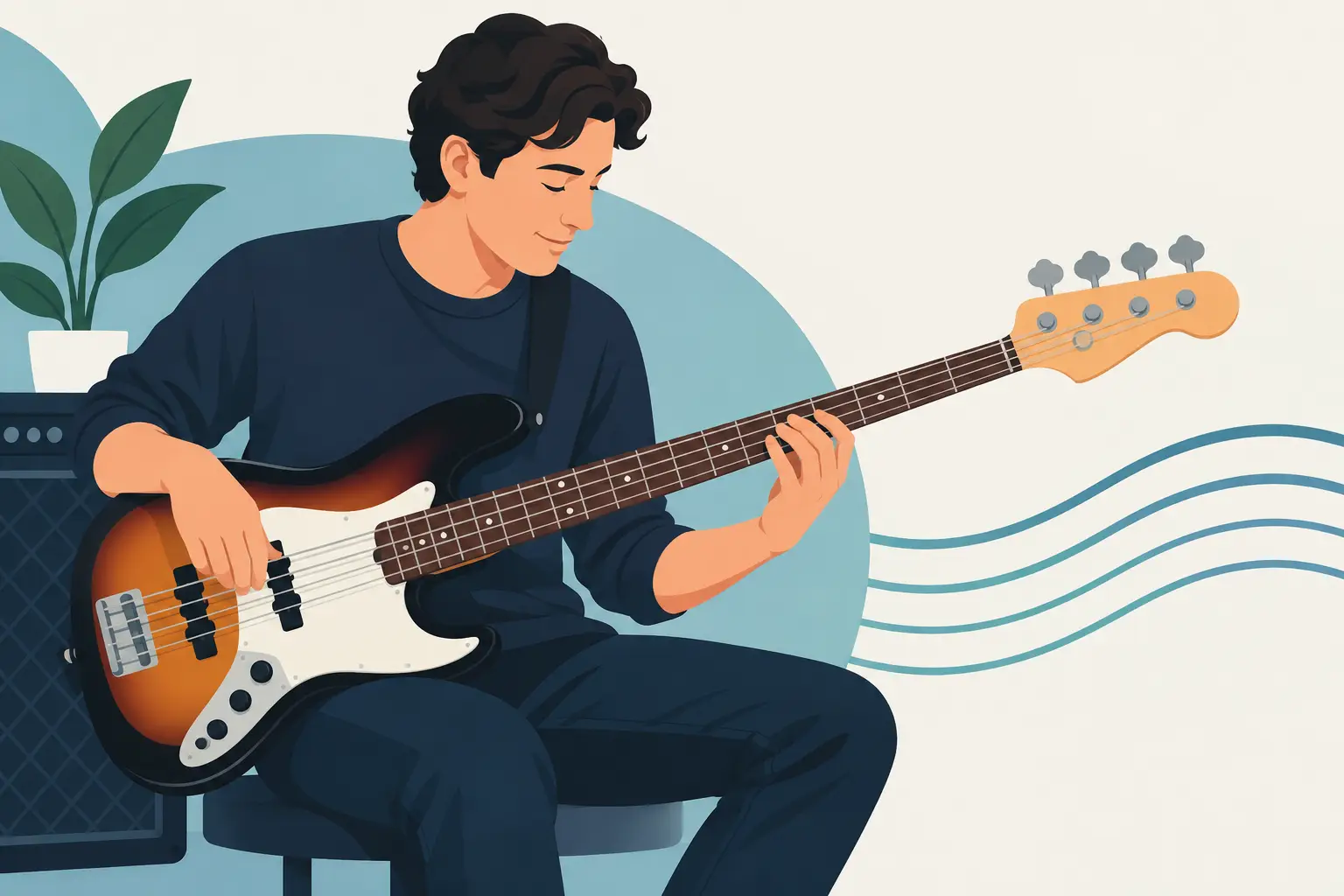
The bass is not just the guitar’s bigger cousin. It is the instrument that helps a song feel solid, exciting, and impossible not to move to. A great beginner bass technique guide should help you make musical sounds quickly while building habits that keep your hands comfortable as songs get more challenging.
For new players, the goal is not to play the most notes. It is to make each note feel good. Clean tone, steady rhythm, relaxed hands, and the confidence to play with other people will take you much further than rushing through flashy exercises.
Start With a Comfortable Bass Position
Good technique begins before you play a note. Whether you are sitting or standing, bring the bass to your body instead of bending your body toward the instrument. Keep your shoulders relaxed, your back fairly straight, and the neck angled slightly upward. If the bass hangs too low on a strap, your fretting wrist has to work harder. If it sits too high, your picking arm can feel cramped.
When seated, rest the bass on the thigh that feels most stable. Many right-handed players use the right thigh, but there is no prize for forcing a position that feels awkward. The best position is the one that lets both hands move freely without strain.
Your left thumb should generally rest behind the neck, near the middle of its width. Do not squeeze the neck like a handlebar. Think of the thumb as a gentle support while your fingertips do the work. A relaxed hand may feel less dramatic, but it gives you better reach, cleaner notes, and more endurance.
Pluck With Control, Not Force
Most beginning bass players start by using their index and middle fingers on the plucking hand. Rest your thumb lightly on the pickup or on a lower string for stability. Then alternate your index and middle fingers as you pluck: index, middle, index, middle.
Pluck across the string with a small, controlled motion. You do not need to pull the string far away from the bass. Too much force can create a clanky sound, make your rhythm uneven, and tire out your hand. Start softly enough that you can hear the note clearly, then add power only when the music calls for it.
Alternating fingers may feel strange at first, especially when one finger seems stronger than the other. That is normal. Practice slowly with a metronome, using one note at a time. Your job is to make the two fingers sound as similar as possible. A steady, even sound is a much better early goal than speed.
A pick is also a valid way to play bass. It can give you a sharper attack that works beautifully in rock, punk, pop, and many other styles. Learning fingerstyle first gives you a versatile foundation, but the right approach depends on the music you love. Great bassists use the sound that serves the song.
Let Your Thumb Move When It Needs To
As you begin playing the thicker E string and move across the instrument, your thumb may need a new resting spot. This is often called movable anchoring. Resting your thumb on the string above the one you are playing helps keep your hand balanced and reduces unwanted noise.
For example, when plucking the A string, let your thumb rest on the E string. When plucking the D string, your thumb can rest on the A string. It may seem like a small detail, but it helps your bass sound focused instead of muddy.
Fret Notes Cleanly Without Crushing the Strings
Place the tip of your fretting finger just behind the metal fret, not directly on top of it and not far back in the space between frets. This lets you get a clear note with less pressure. If you hear buzzing, first check your finger placement before pressing harder.
Use the tips of your fingers and keep your knuckles rounded. Your first finger is usually numbered 1, followed by 2, 3, and 4 for your pinky. Early exercises often assign one finger to each fret position. This builds useful coordination, but do not stretch your hand painfully to obey a pattern. Shift your whole hand when the distance is too large.
New players sometimes press every string against the neck with all their strength. That creates sore hands and slows you down. Try this experiment: fret a note, pluck it, then gradually ease off the pressure until the note begins to buzz. Add back only enough pressure for a clean sound. That is closer to the amount of force you need.
Learn to Mute Every String You Are Not Playing
Muting is one of the biggest differences between a bass line that sounds polished and one that sounds messy. Bass strings are long, thick, and eager to ring out. If you only focus on the note you are playing, the other strings may hum along in the background.
Your plucking hand can mute lower strings with the thumb, while your fretting hand can lightly touch higher strings that are not supposed to sound. You do not need to solve all muting at once. Start by noticing extra noise. Then pause, identify which string is ringing, and experiment with lightly touching it.
This is also where slow practice pays off. A simple four-note pattern played cleanly is real progress. A complicated pattern with ringing strings is just a noisy problem waiting to be fixed.
Treat Rhythm as Your Main Job
Bass players connect the drums, harmony, and melody. That means your timing matters as much as your note choices. You can play only two notes in a measure and still make the whole band feel stronger if those notes land in the right place.
Practice with a metronome, drum loop, or backing track as soon as possible. Begin with quarter notes: one note on each click. Count out loud, “1, 2, 3, 4,” while you play. Next, try eighth notes by playing two even notes per click and counting, “1 and 2 and 3 and 4 and.”
Do not race the click. Do not drag behind it either. Listen for the feeling of your note sitting right in the beat. If the tempo feels difficult, slow it down until you can play with a relaxed body and a consistent sound. Slow practice is not a detour from progress. It is where reliable groove begins.
Practice the Spaces Between Notes
Beginners naturally concentrate on what to play next. Bass players also need to notice when not to play. The silence after a note has rhythm, too. Try playing one note on beat 1, then muting it cleanly and counting the rest of the measure. This simple exercise teaches control, makes your lines punchier, and helps you listen to the music around you.
Use a Short Practice Routine You Can Repeat
A focused 15-minute session can create more improvement than an hour of distracted playing. Keep your routine simple enough that you will actually return to it, even on a busy school night or after a long workday.
A helpful beginning session includes these four parts:
- Spend a few minutes warming up with slow finger alternation on one string.
- Play a fretting exercise that moves across a few nearby frets without tension.
- Practice a rhythm pattern with a metronome or drum beat.
- Finish with a song, riff, or bass line you genuinely enjoy.
The fun part matters. Songs give technique a purpose. If your child loves a favorite pop chorus or you have always wanted to play classic rock, country, worship music, or funk, bring that music into practice. The right song can motivate you to repeat a difficult section enough times for your hands to learn it.
Watch for Tension Before It Becomes Pain
A little fingertip tenderness is common when you begin. Sharp pain, numbness, burning, or pain that continues after playing is a sign to stop and reassess. Check your posture, strap height, hand position, and how hard you are pressing. A bass that needs setup work can also make beginner technique much harder than it should be.
Take short breaks. Shake out your hands. Keep your wrists from bending sharply for long periods. Players with smaller hands, younger students, and adults returning after years away may need more frequent shifts and a slower approach. There is no one hand size or body type required to become a strong bassist.
Put Your Technique to Work With Other Musicians
Playing along with recordings is helpful, but playing with real people teaches a different kind of listening. You learn to lock in with a drummer, recover after a missed note, follow a song’s form, and keep going without losing your place. Those skills build confidence fast.
At Matt Burk Music Studio, bass students can grow beyond weekly exercises through supportive coaching, jam sessions, band experiences, and performance opportunities. That kind of musical community reminds beginners that technique is not about perfection. It is about giving you the freedom to join in, create a groove, and share music with others.
Your first bass line might be simple, and that is exactly where it should start. Keep your hands relaxed, listen closely, and celebrate every cleaner note and steadier beat. Before long, someone will start tapping a foot because of the groove you created.