
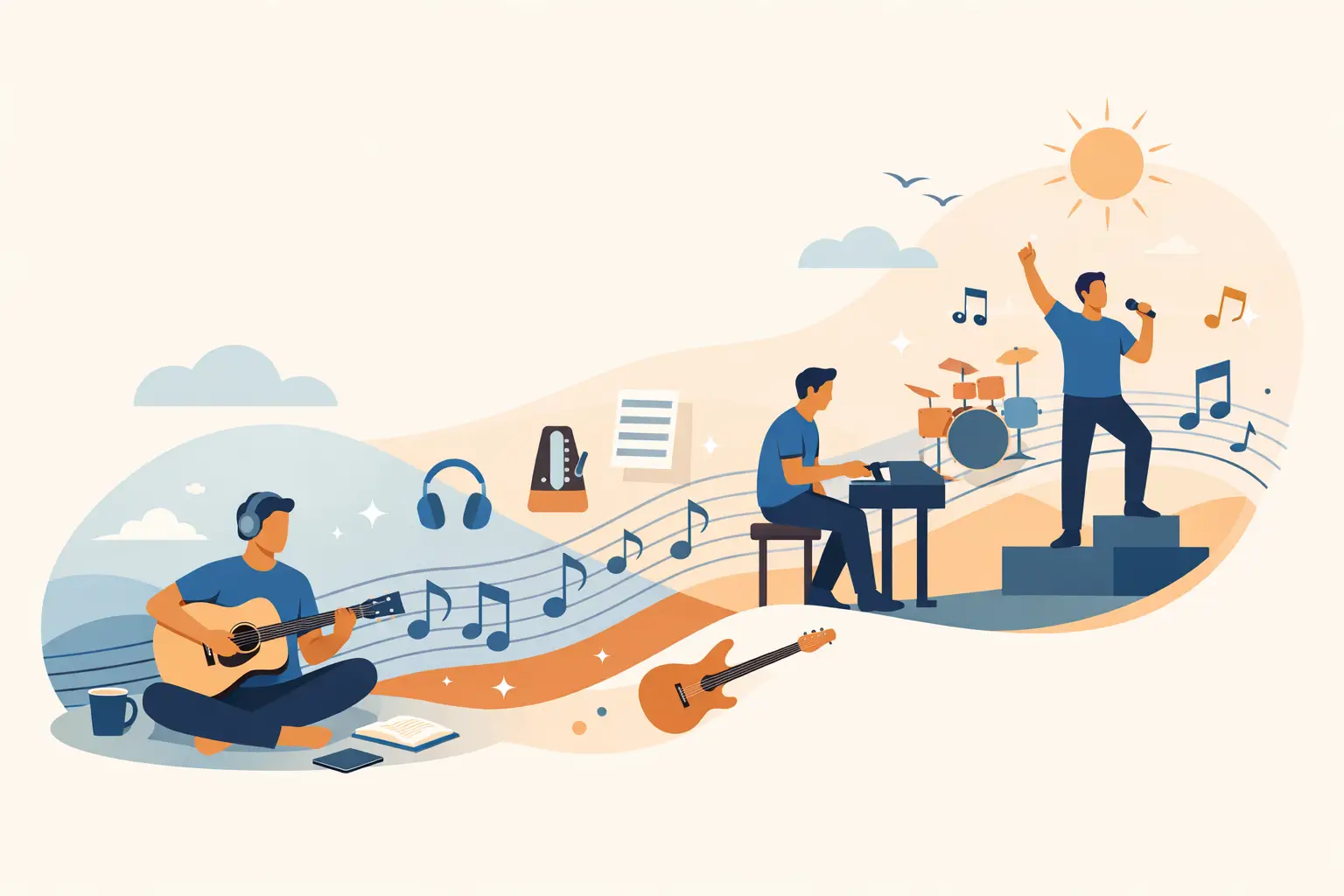
You do not need to be a child prodigy, own fancy gear, or have a lifelong background in the arts to start making music. An adult beginner music journey usually begins in a much more ordinary place - after work, between family responsibilities, or during a season when you finally decide to do something for yourself. That is exactly why it matters. Learning music as an adult is not about catching up. It is about building something meaningful, enjoyable, and personal at your own pace.
Why the adult beginner music journey feels different
Adults often walk into their first lesson carrying more than curiosity. They bring expectations, self-doubt, busy calendars, and the quiet fear of looking inexperienced. Kids rarely worry about being bad at the beginning. Adults do, and that can make the first step feel bigger than it really is.
The good news is that adults also bring real strengths. You know how to commit to goals. You understand what kind of encouragement helps you stay consistent. You usually have a clearer reason for starting, whether that is learning worship songs, playing favorite classics, singing with confidence, joining a band, or simply having a creative outlet that is yours.
That combination matters. Progress is not just about raw talent. It is about steady effort, good instruction, and a learning environment that makes you want to keep showing up.
What makes adults improve faster than they expect
A lot of beginners assume music is only for people who started young. In reality, adult students often make strong progress because they are intentional. They ask better questions. They notice patterns. They connect technique to real goals.
The key is starting with a plan that fits your life instead of trying to copy someone else's. If you only have twenty focused minutes a day, that can still work. If you want to learn guitar so you can play around the house, your lesson path should look different from someone training for live performance. If voice lessons are your starting point, you may need confidence coaching as much as pitch work at first.
This is where personalized instruction changes everything. Generic tutorials can be helpful in small doses, but they cannot adjust to your pacing, your habits, or your goals. A great teacher sees what is holding you back and helps you improve without making the process feel heavy or intimidating.
The first stage of an adult beginner music journey
Most adult beginners need two things right away - early wins and realistic expectations. Early wins create momentum. Realistic expectations keep you from quitting when the newness wears off.
At the beginning, progress may look small from the outside. You learn how to hold the sticks correctly, where middle C is, how to switch between two chords, how to breathe before a vocal phrase, or how to count a basic rhythm without freezing up. Those are not minor details. They are the foundation for everything that comes next.
This stage is also where many adults make the mistake of judging themselves too early. If your fingers feel awkward on piano or guitar, that is normal. If your voice feels exposed, that is normal. If reading music seems slow at first, that is normal too. Starting music is not a test of whether you belong. It is simply the beginning of training skills you do not have yet.
Picking the right instrument matters more than picking the perfect one
Adults sometimes get stuck before they begin because they are trying to choose the one perfect instrument. Usually, the better question is simpler. What are you excited to hear yourself doing six months from now?
If you love singing along in the car and want to feel more confident using your voice, start there. If you picture yourself playing songs at home, piano, guitar, or ukulele might be a strong fit. If rhythm is what grabs you first, drums or bass could be the right door into music. If you are drawn to recording and creating, music production may keep you engaged in a way traditional lessons do not.
There are practical trade-offs, of course. Piano gives you a clear visual layout of music. Guitar is portable and social. Voice requires no instrument purchase but can feel vulnerable at first. Drums are exciting but need a setup that works in your space. The best choice is usually the one you are most likely to stick with, not the one that seems most impressive.
What keeps adult beginners from quitting
Motivation gets people started. Structure keeps them going.
Many adults quit not because they lack ability, but because they try to rely on inspiration alone. Life gets busy. Work runs late. Kids have activities. Energy dips. When practice depends on feeling motivated, it becomes easy to postpone. A better approach is building a routine that feels manageable enough to repeat.
That may mean shorter practice sessions more often. It may mean keeping your instrument visible instead of tucked away in a closet. It may mean taking lessons at the same time each week so music becomes part of your rhythm instead of another decision to make.
Support matters too. Adult beginners do better when they are in an encouraging environment where mistakes are treated as part of growth, not proof they are failing. That is one reason community-based studios can be so powerful. When lessons include coaching, performance opportunities, and a fun musical culture, students are more likely to stay engaged long enough to see real change.
Confidence grows faster when music is shared
Private practice is important, but private practice alone can make progress feel invisible. Many adults gain confidence when they have opportunities to play or sing for others in low-pressure settings.
That does not mean you need to be ready for a packed room right away. Sometimes growth starts with a casual jam session, an open mic, a studio event, or simply playing one song all the way through for a supportive audience. Those moments shift music from something you are trying to learn into something you are actually doing.
For many adult students, that is the turning point. They stop thinking of themselves as someone who wishes they could play music and start seeing themselves as a musician in progress. That identity shift is powerful, especially when it happens in a community that cheers for effort as much as outcome.
The value of lessons built around your goals
Adult beginners thrive when lessons feel relevant. If every week feels disconnected from the music you care about, motivation drops quickly. But when your lessons connect technique to songs, styles, and milestones that matter to you, practice starts to feel rewarding.
Maybe your goal is to sing without feeling tense. Maybe you want to play piano at church, learn acoustic guitar for family gatherings, join a band, or finally understand music production. Each of those goals calls for a different emphasis. Good instruction does not force every student through the same path. It adapts.
That is one reason adult learners in Allen and Frisco often look for a studio experience instead of random one-off lessons. A student-first approach with flexible scheduling, kind instructors, and clear next steps removes a lot of the friction that causes adults to stop before they really begin. At Matt Burk Music Studio, that kind of personalized support helps students move from first lesson nerves to genuine confidence.
Progress is rarely linear, and that is okay
One week you may feel great. The next week the same song seems harder than it did before. That does not mean you are going backward. Music development tends to happen in layers. Your ear improves, then your timing catches up. Your hands learn the motion, then your accuracy improves. Your confidence rises, then nerves show up again when you perform.
This is where patience matters. Adult beginners often want to measure progress only by big visible outcomes, but the quieter gains count too. Better rhythm, cleaner transitions, less hesitation, stronger breath control, more comfort in a lesson - these are signs that your foundation is getting stronger.
If you stay with it, those small gains stack up. The song that felt impossible starts to feel familiar. The instrument that felt awkward starts to feel like yours. The idea of performing stops sounding scary and starts sounding exciting.
A strong start beats a perfect plan
If you have been waiting until life calms down, until you feel more confident, or until you are sure you will be good at it, you may be waiting much longer than you need to. The truth is that most successful adult students do not begin with certainty. They begin with interest, a little courage, and the willingness to try.
That is enough.
The best adult beginner music journey is not the fastest one or the most impressive one. It is the one you can sustain. It fits your schedule. It respects your goals. It gives you support when you need it and challenges you when you are ready. Most of all, it reminds you that learning music can be joyful, even while it stretches you.
If music has been sitting in the background of your life for years, this may be your moment to move it to the front. Start where you are, let yourself be new at it, and give your future self something wonderful to look forward to each week.