
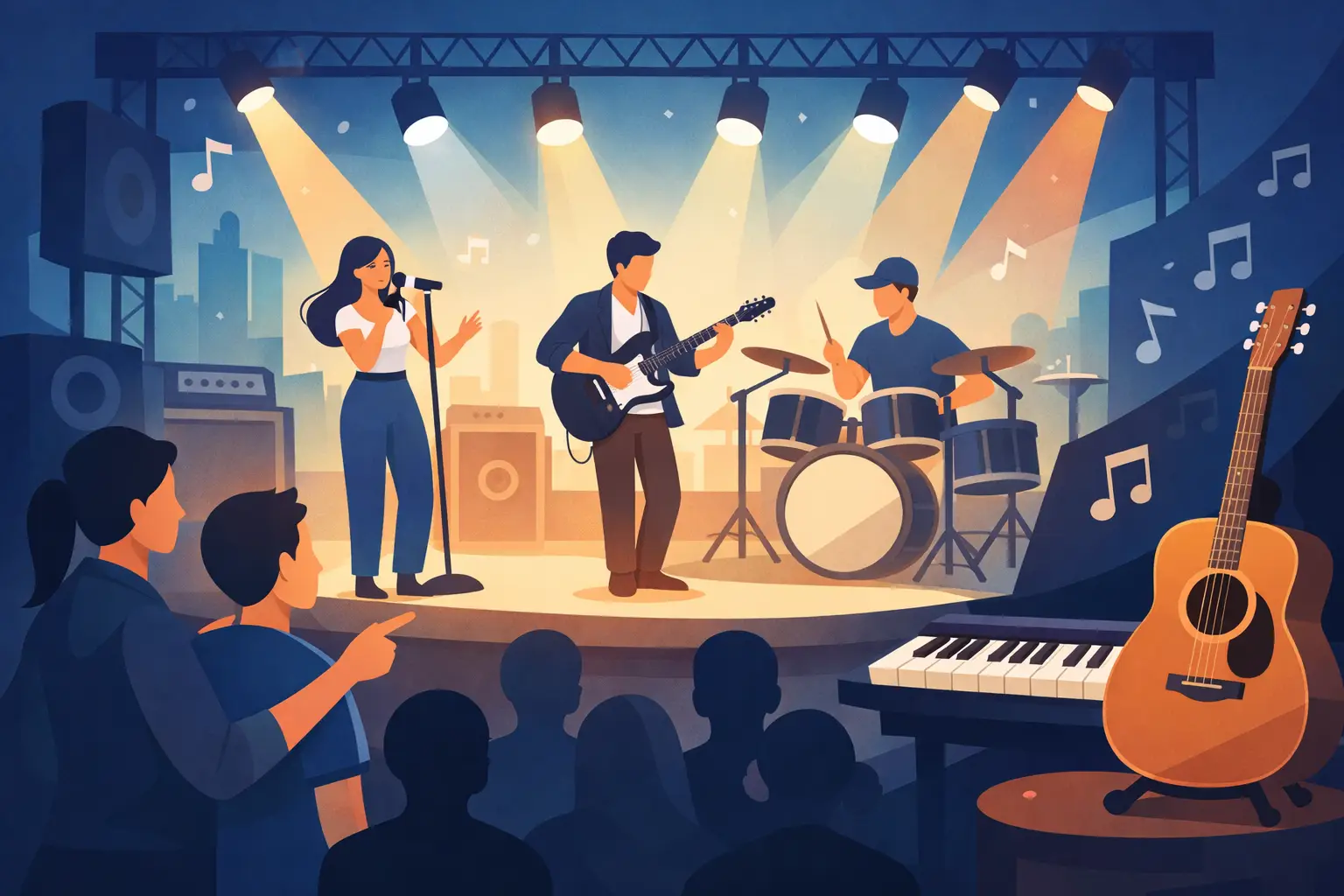
Some students love practicing at home but freeze up the moment someone says, "Play that for us." Others are eager to perform, but they have no idea how to prepare for a real stage. That gap is exactly why a music school with live performance can make such a big difference. It gives students more than weekly lessons. It gives them a reason to grow, a place to apply what they learn, and the kind of confidence that only comes from doing the real thing.
For many families and adult learners, this changes the whole experience of music lessons. Progress feels more exciting when there is a clear goal ahead. A recital, an open mic, a band performance, or a local venue show turns practice into something meaningful. Students are not just learning notes and technique. They are learning how to share music with other people.
What makes a music school with live performance different?
A traditional lesson studio may do a good job teaching fundamentals. Students learn songs, scales, rhythm, and technique. That foundation matters. But when performance is missing, music education can stay private for too long.
A music school with live performance adds another layer of growth. Students still build the basics, but they also learn how to play through nerves, recover from mistakes, communicate with an audience, and stay steady under pressure. These are real skills. They do not show up fully in a practice room.
That does not mean every student needs to become a professional performer. Not at all. Live performance helps beginners, hobbyists, kids, teens, and adults because it gives music a purpose beyond the lesson itself. Even one performance opportunity can help a student sit taller, play with more conviction, and believe in what they are capable of.
Live performance builds confidence faster
Confidence is one of the biggest reasons parents look for more than basic lessons. They want their child to enjoy music, but they also want them to grow as a person. Performance can help with that in a powerful way.
When a student prepares for a live event, they learn how to stick with a goal over time. They practice more intentionally. They pay closer attention to details. Then they step on stage, get through the song, and realize they can do hard things. That moment matters.
For adults, the confidence boost can be just as meaningful. Many adult students carry old stories about not being musical enough or starting too late. Performing, even in a supportive community setting, can help rewrite those stories. It is one thing to say, "I'm learning guitar" or "I take voice lessons." It is another thing to actually perform and feel that progress in a real-world setting.
Of course, timing matters. Not every student should be pushed onto a stage too soon. A good studio knows how to pace performance opportunities so they feel motivating, not overwhelming. Sometimes the right first step is a low-pressure open mic. Sometimes it is a group class, jam session, or studio event before a bigger venue performance. It depends on the student, their goals, and where they are in the process.
Why stage experience improves musicianship
Performance is not only about confidence. It also sharpens musical skill in ways that private practice cannot.
When students know they will perform, they listen differently. Their rhythm gets more solid. Their transitions get cleaner. They start noticing what makes a song feel complete from beginning to end. Instead of stopping every few measures, they learn to keep going. That is a huge step forward.
Live playing also teaches flexibility. Maybe the room sounds different than expected. Maybe the tempo shifts a little. Maybe a student forgets a lyric or misses a chord. In lessons, those moments can feel frustrating. On stage, students learn how to recover and move forward. That resilience is part of becoming a real musician.
In band settings, the growth is even more visible. Students learn how to count in, lock into a groove, listen across the group, and support each other musically. These skills are hard to develop in isolation. They come alive when students rehearse and perform together.
The best performance programs do more than schedule recitals
Not all performance opportunities are equal. Some studios treat performance as an occasional extra. Others build it into the learning journey from the start. That difference matters.
A strong program does not just put students on stage and hope for the best. It prepares them. That means coaching on stage presence, song selection, rehearsal habits, and what to expect before, during, and after a performance. Students need support at every step.
They also need variety. Recitals are valuable, but they are only one format. Open mic nights, jam sessions, band classes, masterclasses, and community events each teach something different. A student who is nervous alone may thrive in a group performance. A student who loves writing songs may gain the most from a smaller showcase setting. The right mix helps more students succeed.
This is where community becomes a major advantage. When students are surrounded by kind instructors, encouraging peers, and families who cheer each other on, performing feels less intimidating. It becomes something to look forward to instead of something to fear.
How to choose the right music school with live performance
If you are comparing music programs, it helps to look beyond the phrase itself. Plenty of studios mention performance, but the real question is how they deliver it.
Start by asking what kind of performance opportunities students actually get. Are events held regularly, or only once in a while? Are students performing in respected local venues or only in a classroom? Is there a clear path from beginner lessons to more advanced stage experiences?
Then look at the support around those events. Do instructors coach students through preparation, or are families expected to figure it out on their own? Are there options for different ages, experience levels, and personalities? A seven-year-old beginner and an adult returning to piano after twenty years may both want to perform, but they will not need the same approach.
Flexibility matters too. Some students want to move toward performance quickly. Others need time. The best schools keep the process student-centered. They challenge students, but they also respect individual pace and goals.
For families in Allen and Frisco, this often comes down to finding a place that feels both professional and welcoming. You want experienced teachers, organized programs, and clear progress. But you also want a studio where students feel safe to try, make mistakes, and grow. That balance is where the best results happen.
Why families and adult learners stay longer in performance-based programs
One reason students quit music lessons is that the experience starts to feel repetitive. Weekly lessons without visible milestones can lose momentum, especially for kids and teens with busy schedules.
Performance changes that. It gives students something to work toward and something to celebrate. Each event becomes a marker of progress. Students can look back and see how far they have come, from their first few notes to playing confidently in front of an audience.
That sense of momentum helps with retention, but it also helps with joy. Music becomes social, memorable, and exciting. Students build friendships. Families get to see growth firsthand. Adult learners reconnect with creativity in a way that fits real life, not an all-or-nothing ideal.
At a community-focused studio like Matt Burk Music Studio, that journey can include private lessons, band experiences, jam sessions, and performance opportunities at well-known local venues. For many students, that is the missing piece. They do not just want instruction. They want a path that helps them become confident, expressive musicians in the real world.
A music school with live performance gives lessons a purpose
The best music education is not just about getting through a method book or checking off skills. It is about helping students become more capable, more expressive, and more confident over time.
That is why live performance matters. It turns learning into action. It helps students connect discipline with excitement, preparation with pride, and practice with real payoff. It gives children a chance to grow braver, teens a place to belong, and adults permission to pursue something meaningful.
If you are looking for music lessons, do not just ask what instrument is taught. Ask where those lessons can lead. A supportive music school with live performance can help students do more than learn songs. It can help them share their gifts, enjoy the process, and surprise themselves in the best possible way.