
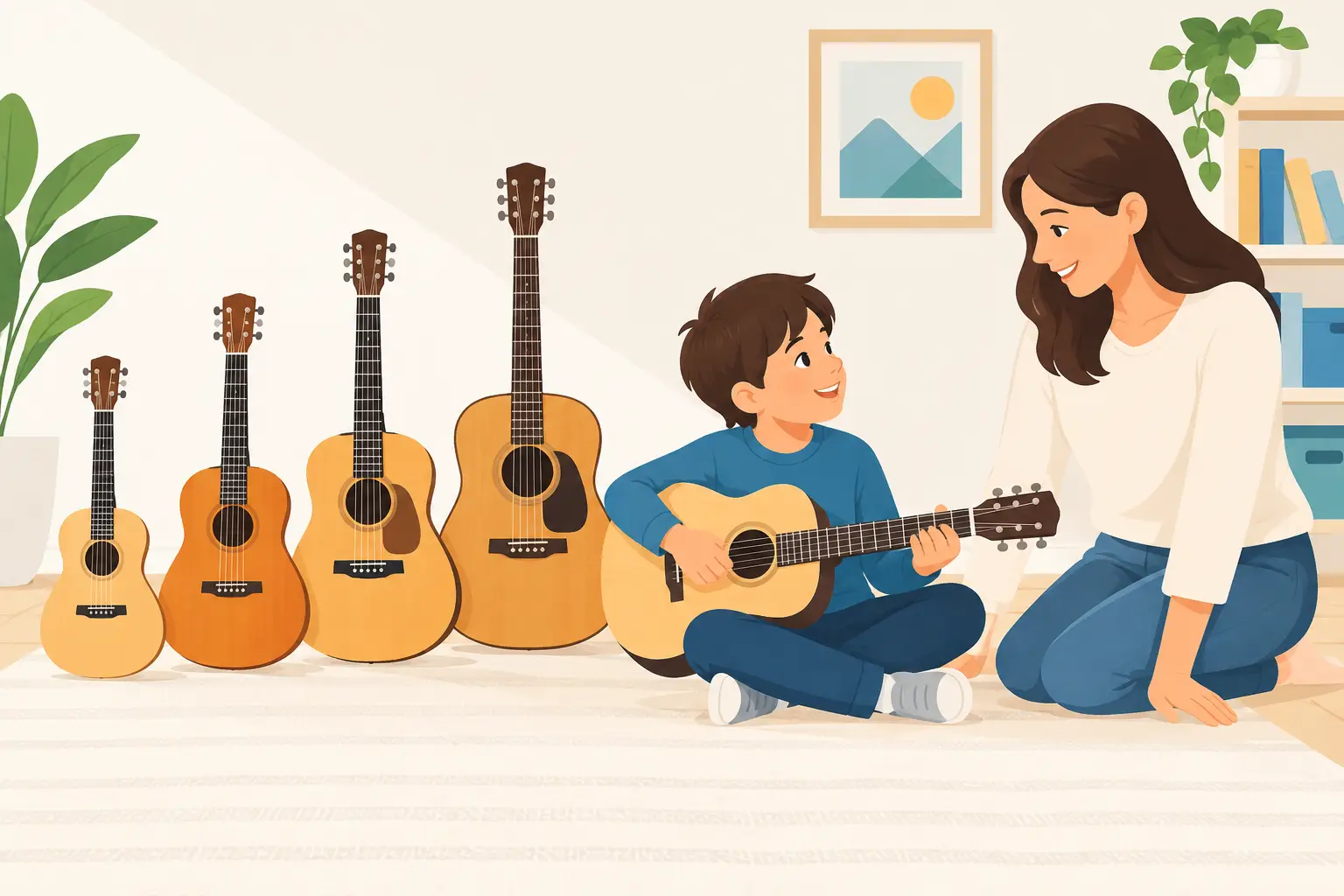
A guitar that is too big can turn an excited first lesson into a frustrating wrestling match. When parents ask which guitar size fits children, the best answer is not based on age alone. A comfortable fit helps a child hold the instrument correctly, reach the strings with confidence, and spend more energy making music instead of fighting the guitar.
The good news is that choosing a child-sized guitar is simpler than it may seem. Start with your child’s height, arm reach, and comfort level, then let them try the instrument in a seated playing position. The right guitar should feel manageable from the first chord, while leaving room for steady growth.
Which Guitar Size Fits Children by Age and Height?
Guitar sizes are usually described as fractions of a full-size instrument. These labels are helpful starting points, but they are not perfectly standardized across every brand. One company’s 3/4 guitar may be slightly different from another’s, so physical comfort matters more than the number on the label.
| Guitar size | Typical age range | Typical child height | Best use | |---|---:|---:|---| | 1/4 size | 4-6 years | Under 3 feet 9 inches | Young beginners with shorter arms and smaller hands | | 1/2 size | 5-8 years | About 3 feet 9 inches to 4 feet 3 inches | Early elementary students | | 3/4 size | 8-11 years | About 4 feet 3 inches to 4 feet 9 inches | Older elementary students and many preteens | | Full size | 11+ years | Around 4 feet 9 inches and taller | Teens, taller preteens, and adults |
These ranges overlap for a reason. A tall seven-year-old may be ready for a 1/2-size or even a 3/4-size guitar, while a petite 10-year-old may feel much more successful on a 3/4-size model. Growth matters, but comfort today matters more. A child who cannot enjoy practicing now is unlikely to stick with the instrument long enough to outgrow it.
Check the Fit Before You Buy
Age and height narrow down the choices, but a quick fit check gives you the most reliable answer. Have your child sit in a chair with both feet supported on the floor or a small footstool. Place the guitar on the leg they would naturally use for playing, usually the right leg for right-handed players.
The guitar’s body should rest against their torso without sliding away or forcing them to lean backward. Their fretting hand should reach the first few frets without fully straightening the elbow or lifting the shoulder. If they have to stretch, twist their wrist sharply, or hunch over the instrument, the guitar is probably too large.
Next, look at the picking arm. Their forearm should rest comfortably over the body, with the hand reaching the strings near the sound hole or pickups. If the body is so wide that their shoulder rises high or their arm barely reaches the strings, try a smaller body shape.
A little growing room is fine. A guitar that feels like a giant is not. Good posture gives children a strong foundation for clean chords, relaxed hands, and confident playing as their skills develop.
The neck matters as much as the body
Parents often focus on guitar length, but the neck can make an even bigger difference. Children with small hands benefit from a shorter scale length, meaning the distance from the nut to the bridge is shorter. This places the frets closer together and reduces the stretch required for chords.
Neck width also matters. Classical guitars often have wider, flatter necks, while many steel-string acoustics and electric guitars have narrower necks. Neither is automatically better. A child may find the wider classical neck comfortable for individual notes, while another prefers the slimmer feel of an electric guitar neck. Trying both can be very helpful.
Acoustic, Classical, or Electric: What Changes?
The size chart is a useful guide, but the type of guitar changes the decision. An acoustic guitar, classical guitar, and electric guitar can feel very different even when they carry the same size label.
Classical guitars are often friendly for young beginners
A nylon-string classical guitar can be a comfortable first choice, especially for younger children. Nylon strings are gentler on fingertips than steel strings, and many student classical guitars are available in 1/4, 1/2, and 3/4 sizes. Their wider necks take a little getting used to, but the softer strings can make early practice more pleasant.
Steel-string acoustics need careful sizing
Steel-string acoustic guitars produce the bright, familiar sound many kids recognize from favorite songs. They also require more finger pressure, particularly if the strings sit high above the fretboard. A properly set up guitar can make a major difference. Even a correctly sized guitar may feel difficult if the action is too high, so ask a knowledgeable teacher or guitar shop to check it.
Smaller-body acoustic models can be an excellent choice for children. Look beyond the fraction label and notice the body depth, upper-bout width, and overall weight. A compact guitar is easier to hug, hold, and control.
Electric guitars can be a great first instrument
Many children thrive on electric guitar because the strings are typically easier to press and the necks are often slimmer. A short-scale electric guitar can be especially comfortable for smaller hands. It does require an amplifier, cable, and a little attention to volume, but it also gives kids access to the sounds they love.
If your child is excited by rock, pop, blues, or modern worship music, an electric guitar may keep their motivation high. The best beginner guitar is often the one a child cannot wait to pick up again.
Avoid the “They’ll Grow Into It” Trap
Buying a full-size guitar for a young child can seem practical, especially when you want to avoid replacing an instrument in a couple of years. But an oversized guitar can create habits that are hard to correct later. Children may squeeze too hard, bend their wrist, raise their shoulder, or avoid practicing because every chord feels difficult.
A smaller guitar is not a lesser guitar. It is the right tool for the stage your child is in. A quality student instrument that fits well will help them develop rhythm, coordination, musical listening, and confidence. Those wins are worth far more than trying to stretch one purchase through several years of growth.
There is one exception: a child who is right on the edge between sizes and can play the larger instrument with relaxed posture may be ready to size up. That decision should come from how the guitar feels in their hands, not simply from a birthday on the calendar.
Make the First Guitar Feel Like Their Guitar
Fit is essential, but excitement counts too. Let your child have a voice in the color, style, or sound of their instrument once you have narrowed the choices to models that fit. Feeling ownership can make practice feel less like homework and more like a personal creative outlet.
Do not overlook a few simple essentials. A tuner, a comfortable strap, a small footstool if needed, and a protective case help children build good habits. For acoustic and classical players, a simple pick variety pack is useful, though some beginners may start by strumming with their fingers. For electric players, keep the setup simple and choose a manageable practice volume.
Most importantly, have the guitar adjusted if it feels hard to play. Proper string height, fresh strings, and a stable tuning setup can turn a discouraging instrument into one that invites daily practice.
Let a Teacher Help Confirm the Right Size
A knowledgeable guitar instructor can spot fit issues quickly. During a first lesson, they can watch how your child holds the guitar, reaches the neck, and responds to basic chord shapes. That feedback is especially valuable if your child falls between common size ranges or is choosing between acoustic, classical, and electric guitar.
At Matt Burk Music Studio, our instructors meet students where they are and help families make choices that support real progress. A free trial lesson is a fun, low-pressure opportunity to see what feels comfortable, discover what music motivates your child, and begin building skills with encouraging guidance.
Your child does not need the biggest guitar, the most expensive guitar, or the guitar another child plays. They need one that fits their body, matches their musical interests, and makes them feel ready to create something wonderful.