
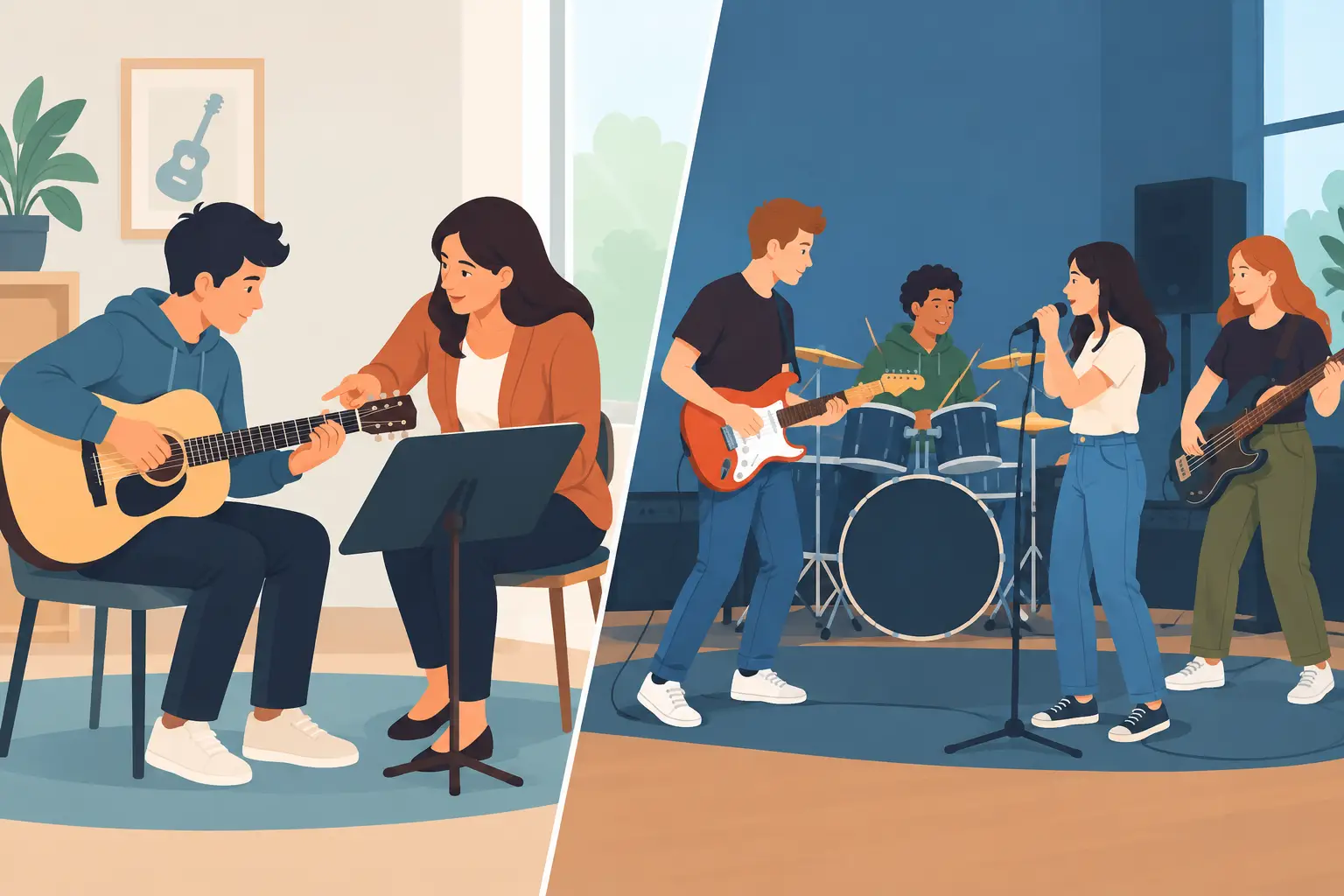
A child who loves singing along to every song in the car may need something different from a teen who wants to start a rock band with friends. That is why the choice between private lessons versus band classes is less about finding the “best” option and more about finding the right next step for the musician in front of you.
Both paths can be exciting, confidence-building, and deeply rewarding. Private instruction gives students focused guidance on their own goals, while band classes teach the real-life skill of making music with other people. For many students, the strongest musical journey includes both at different points along the way.
Private Lessons Versus Band Classes: The Core Difference
Private lessons are built around one student, one instructor, and a personalized plan. A beginning piano student might spend time learning hand position, reading rhythms, and playing favorite songs. A more experienced guitarist may focus on soloing, songwriting, audition preparation, or polishing a performance piece.
Band classes bring several musicians together to rehearse songs, listen closely, communicate, and perform as a group. Students learn how their instrument fits into a larger sound. They also discover that playing the right notes is only part of the job. Timing, dynamics, preparation, flexibility, and teamwork matter just as much.
Neither format is automatically better. The right choice depends on a student’s current skill level, goals, personality, schedule, and comfort with learning around others.
When Private Lessons Make the Most Sense
Private lessons are often the best starting point for beginners. Learning an instrument involves many small skills that are easier to address with individual attention: how to hold sticks correctly, where to place fingers on a guitar, how to breathe for singing, or how to keep a steady beat without rushing.
An experienced instructor can spot habits early and adjust the lesson in the moment. If a student is struggling with a chord change, the teacher can slow it down, try a new exercise, and celebrate progress right away. That kind of personal coaching helps students build a foundation without feeling left behind.
Private instruction is also ideal for students with specific goals. Maybe your child wants to prepare for school band, theater auditions, or a talent show. Maybe you are an adult returning to piano after years away and want to play songs you genuinely enjoy. A private teacher can shape each lesson around that destination.
For shy students, one-on-one instruction can feel safer, too. They get room to ask questions, make mistakes, and find their musical voice without the pressure of peers listening. As confidence grows, those students are often more ready to step into a group setting later.
The advantage of a personalized pace
Every musician learns differently. One student may understand rhythm instantly but need extra help with note reading. Another may learn songs quickly by ear but need support with technique. In private lessons, progress does not have to follow the pace of a class.
That does not mean private lessons should feel isolated or overly serious. Great instruction can be full of favorite music, creative challenges, encouragement, and clear wins from week to week. The goal is to help students enjoy the work because they can feel themselves improving.
What Band Classes Teach That Solo Practice Cannot
A musician can practice perfectly at home and still feel surprised the first time they play with a drummer, singer, bassist, and guitarist. A band class turns that new challenge into a guided, supportive experience.
Students learn to enter at the right moment, stay with the beat, recover when something goes wrong, and listen beyond their own part. They begin to understand musical roles. A drummer learns how to support a singer. A guitarist learns when not to play. A vocalist learns how to connect with an audience while trusting the band behind them.
Those skills are hard to learn from a worksheet or a practice app. They come from showing up, trying again, and hearing the group improve together.
Band classes can be especially powerful for social, energetic students who are motivated by a shared goal. Rehearsing toward a performance gives practice a purpose. Instead of asking, “Why do I need to work on this part again?” students can hear exactly how their preparation helps the whole group sound better.
Confidence grows differently in a group
Performing with others can make a student feel less exposed. They are not carrying the entire song alone. At the same time, they learn responsibility because everyone depends on everyone else.
That balance can be transformative. Students gain the courage to be heard while learning humility, patience, and respect for other musicians. A successful rehearsal often creates the kind of confidence that follows students well beyond music class.
The Trade-Offs Families Should Consider
Private lessons provide precision. Band classes provide collaboration. The trade-off is that a band instructor must divide attention among multiple students, so a group setting cannot offer the same level of individualized technical feedback during every rehearsal.
For that reason, a student who is brand new to an instrument may benefit from private lessons before joining a band. They do not need to be perfect. In fact, waiting for perfection can keep students from enjoying the group experience too long. But they should have enough basic comfort with their instrument to follow simple directions, play a few foundational patterns, and keep working when the music gets challenging.
Schedule is another practical consideration. Private lessons can often be more flexible because they center on one family’s availability. Band classes require a consistent group rehearsal time, and attendance matters. When one member misses rehearsal, the whole group feels the gap.
It is also worth considering what motivates your student. A child who loves individual attention and clear personal milestones may thrive in private instruction. A student who lights up around friends, concerts, and shared projects may be ready for a band experience sooner.
Why the Best Answer Is Often Both
Think of private lessons as the place where musicians build their tools. Band classes are where they learn to use those tools in a real musical conversation.
A private piano student can develop stronger rhythm, learn chords, and build confidence with melodies. In a band, that same student learns how to choose sounds that support a song and stay connected to a drummer. A voice student can strengthen breath control and pitch during private lessons, then practice stage presence and harmony in a group.
This combination creates momentum. Students bring questions from rehearsal back to their private instructor, then return to the band better prepared. Their individual goals and group goals start supporting each other.
At Matt Burk Music Studio, that progression can include private coaching, band experiences, jam sessions, open mics, and performance opportunities at respected local venues. Students are not simply learning notes. They are developing the confidence to share their gifts with an audience.
How to Choose the Right Next Step
Start by asking what your musician wants to do in the next few months. If the answer is, “I want to learn guitar,” “I want to sing with confidence,” or “I need help with the basics,” private lessons are likely the clearest fit. If the answer is, “I want to play with other people,” “I want to perform,” or “I want to be in a band,” a group class may be the spark they need.
Then look honestly at readiness. Can the student play a few songs or patterns with a steady pulse? Are they willing to practice between rehearsals? Can they handle feedback and work with classmates? If the answer is not yet, that is not a failure. It simply points toward building more confidence through personalized instruction first.
Parents do not have to solve the decision alone. A free trial lesson is a low-pressure way to meet an instructor, discuss goals, and get a thoughtful recommendation based on the student’s current abilities and interests.
The right musical path should feel challenging enough to inspire growth and supportive enough to keep the joy alive. Whether your student begins with one-on-one coaching, joins a band, or does both, the most meaningful next step is the one that helps them keep showing up, keep learning, and feel proud of the music they are making.