
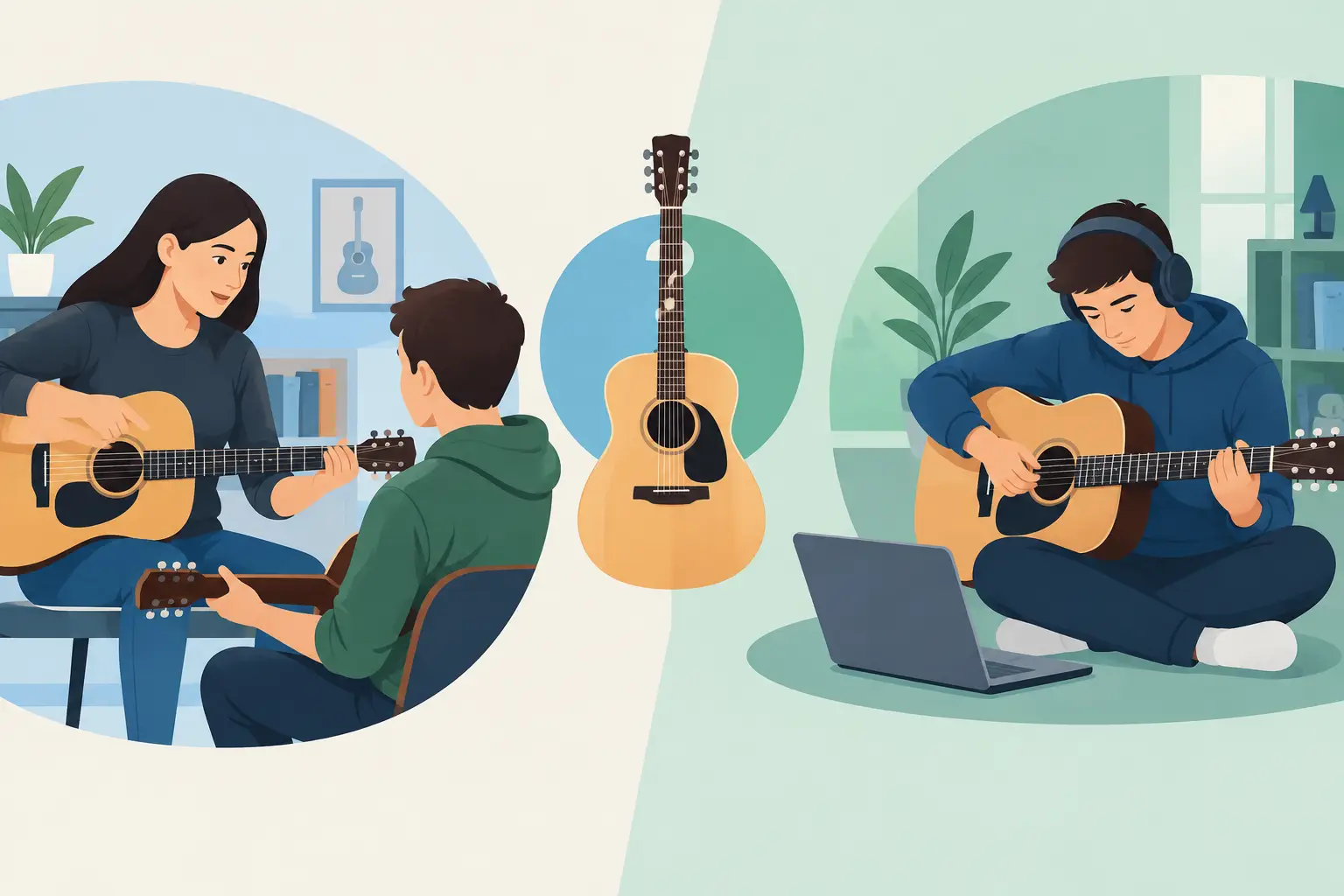
That first clean chord can feel like a tiny victory. Then comes the next question: how do you keep going when your fingers hurt, your chord changes buzz, and the song you love feels just out of reach? Guitar lessons versus self teaching is not a contest with one right answer. Both paths can lead to real musical growth. The best choice depends on what will help you stay excited, make steady progress, and feel confident sharing music with other people.
For some players, learning on their own is a joyful start. For others, a caring teacher turns uncertainty into momentum. Understanding the trade-offs can help you choose a path that fits your goals, schedule, and personality.
Guitar Lessons Versus Self Teaching: The Real Difference
The biggest difference is not talent. It is guidance.
Self-taught guitarists decide what to learn, when to practice, and how to solve problems. That freedom can be wonderful. You can pull up a favorite song after school, learn a riff on a Saturday morning, and explore styles from country to rock to fingerstyle without waiting for a lesson plan.
Private lessons add an experienced set of eyes and ears to the process. A teacher notices whether your wrist is tense, whether your picking hand is working too hard, or whether you are practicing a chord shape in a way that will make harder music more difficult later. Instead of guessing what comes next, you have a plan built around your interests and current ability.
Neither approach makes someone automatically more musical. The player who shows up consistently will always move forward. But the right kind of support can make consistency much easier.
What Self Teaching Does Well
Self teaching gives students ownership from day one. A motivated teen may spend an hour figuring out a favorite solo because they genuinely want to, not because it was assigned. An adult who has always wanted to play campfire songs can learn a few open chords and start making music quickly. That immediate connection to favorite music matters.
It can also be flexible and budget-friendly. There are many videos, chord charts, apps, and play-along tracks available. Students with changing work schedules or busy family calendars may appreciate being able to practice whenever a free moment appears.
Independent learning builds useful skills, too. Self-taught players often become resourceful listeners. They learn to rewind recordings, notice patterns, and experiment until something sounds right. Those habits can serve a musician for life.
The challenge is that online resources are not a personal curriculum. One video may teach simplified chord shapes, another may introduce a scale, and another may promise a shortcut to playing fast. Each resource may be helpful on its own, but it can be difficult for a beginner to know what deserves attention now and what should wait.
Common self-teaching roadblocks
Most self-taught players do not quit because they lack passion. They get stuck in a frustrating loop. They learn the opening of ten songs but cannot finish one. They play familiar chords but avoid the changes that feel awkward. They practice more often when progress is obvious, then stop when they cannot tell whether they are improving.
Technique can become another obstacle. A little discomfort is normal while fingertips build strength, but ongoing hand tension, awkward posture, or poor fretting habits can make guitar feel harder than it needs to be. A video cannot always see what your hands are doing from its side of the screen.
Self teaching works especially well for students who enjoy research, can create their own routine, and are comfortable working through plateaus. It is also an excellent supplement to lessons. Great musicians keep learning independently, even when they have teachers.
Why Guitar Lessons Build Momentum
A good guitar lesson is more than an adult showing a student where to put their fingers. It is a conversation about goals. Maybe a child wants to play songs from a favorite movie. Maybe a teen wants to join a band. Maybe an adult wants to finally play at a family gathering without feeling nervous. The lesson should connect skills to that goal.
Personalized instruction gives beginners a sequence that makes sense: basic posture and tuning, first chords, rhythm patterns, smooth transitions, songs, scales, and musicianship. Students still get to have fun with music they recognize, but they also gain the building blocks that make future songs easier to learn.
Feedback is one of the biggest advantages. A teacher can say, “Your chord is almost there. Move this finger slightly closer to the fret,” and solve a problem in seconds that might have taken weeks to diagnose alone. That kind of encouragement matters, especially for younger students who are still learning how to handle challenge without giving up.
Lessons also create healthy accountability. Knowing that someone is cheering for your progress next week can make a ten-minute practice session feel worth doing on a busy day. For families, it provides a clear picture of what a child is learning and how to support practice at home without turning every reminder into a battle.
The performance advantage
Playing guitar alone in a bedroom and playing for people are two different experiences. Both are valuable, but performance develops skills that tutorials cannot fully teach: recovering after a missed note, keeping time with other musicians, listening, and sharing your personality through a song.
Students who have opportunities to play in jam sessions, open mics, bands, or recitals often find a deeper reason to practice. They are not just preparing for the next lesson. They are preparing to contribute something meaningful. At Matt Burk Music Studio, performance opportunities and community events help students grow from learning songs to confidently making music with others.
The Trade-Offs to Consider
Lessons require an investment of time and money. A weekly appointment may not be ideal for every schedule, and a teacher who pushes a rigid method without listening to a student's interests can drain the fun from guitar. The answer is not simply to take lessons. It is to find a kind, qualified instructor who adapts to the student.
Self teaching costs less at the beginning, but it can cost time if a player repeatedly practices the wrong thing or loses momentum without a clear next step. That does not mean every self-taught musician needs weekly instruction forever. Some students benefit from regular lessons, while others thrive with occasional coaching to reset their goals and improve technique.
Age and learning style matter, too. A curious, independent adult may enjoy building a personal learning plan. A younger beginner often benefits from structure, encouragement, and lessons designed to keep the experience fun. Teens may need both: freedom to choose songs and guidance that helps them develop the skills to play them well.
A Strong Middle Path
You do not have to choose between total independence and total direction. The most successful guitar students often combine the two.
Use lessons to build solid technique, receive feedback, and set meaningful goals. Then use practice time to explore. Learn a riff by ear. Try writing a short progression. Play along with recordings. Bring questions and favorite songs to your teacher. This keeps guitar personal while making sure your effort leads somewhere.
A simple weekly rhythm can help: spend part of your practice time on the skill your instructor assigned, part on a song you enjoy, and a few minutes reviewing something you already know. That balance builds confidence because students can hear both progress and enjoyment every week.
How to Choose Your Next Step
Ask yourself what is getting in your way right now. If you can already find good resources, maintain a practice habit, and solve problems without losing motivation, self teaching may be a great fit. Give yourself a realistic plan and record your playing every few weeks so you can hear your growth.
If you feel overwhelmed by choices, keep hitting the same wall, or want to play with more confidence around others, lessons may be the boost you need. A free trial lesson can be a low-pressure way to see how personalized coaching feels. Pay attention to whether the instructor listens, explains clearly, celebrates effort, and makes you want to pick up the guitar again.
Your guitar journey does not need to look like anyone else's. Start with the support that helps you enjoy the next song, the next challenge, and the next moment you get to share your music.