
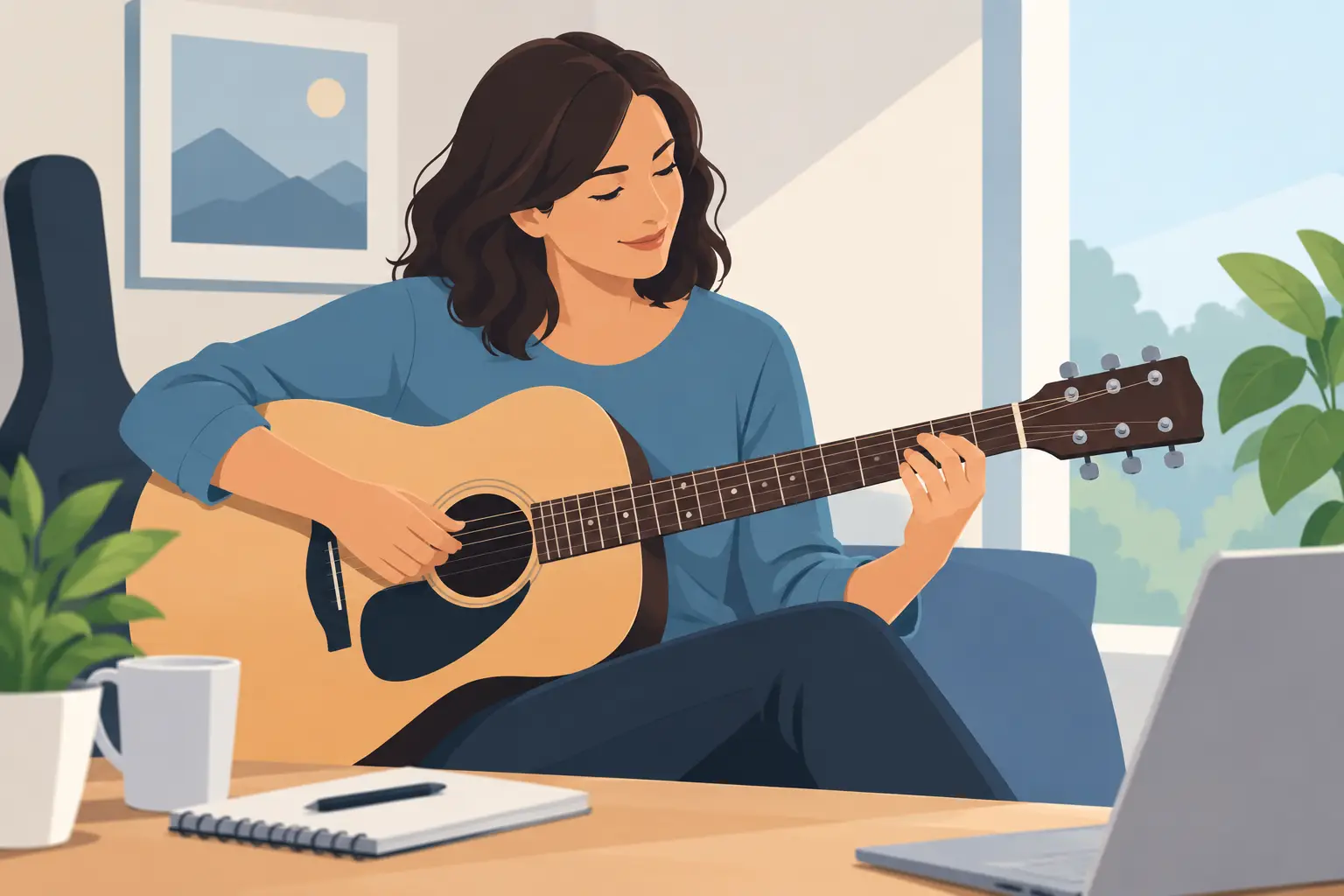
You do not need a childhood of piano recitals or years of choir experience to create an adult beginner success story in music. You need a starting point that feels welcoming, a teacher who listens, and a goal that matters to you. For one adult, that goal might be playing a favorite song after work. For another, it may be joining a band, singing at an open mic, or finally performing for family.
The adults who make the most meaningful progress are not always the ones with the most free time or natural ability. They are often the people who decide that their own creativity deserves a spot on the calendar. They show up, learn one small skill at a time, and let those skills add up.
What an Adult Beginner Success Story in Music Really Looks Like
Success does not have to mean becoming a professional musician. It can mean sitting down at the piano and playing with both hands without freezing. It can mean strumming through a song from beginning to end, keeping a steady beat on drums, or singing with enough confidence to stop apologizing before every note.
That matters because many adult beginners arrive with a story they have been telling themselves for years: “I am too old,” “I am not musical,” or “I should have started when I was a kid.” Those thoughts are understandable, but they are not a prediction of what you can do next.
Adult students bring strengths that children are still developing. You know what music moves you. You can identify a meaningful goal. You understand the satisfaction of practicing toward something and seeing a result. When instruction is personalized around your interests, learning music becomes less like homework and more like a rewarding part of your week.
A good first goal is specific and personal. Instead of saying, “I want to get good at guitar,” try, “I want to play and sing three songs at a backyard gathering.” Instead of “I want to learn piano,” try, “I want to play the intro to the song I listened to with my dad.” A clear goal gives every lesson a direction.
The Moment Progress Starts Feeling Real
Most adult beginners do not wake up one day and suddenly feel like musicians. Confidence usually arrives in quieter moments. You recognize a chord progression. Your hands find the right notes without as much searching. You make it through a verse and realize you did not stop.
Those moments are easy to overlook, especially when you compare yourself to an artist with decades of experience. But they are the evidence that your effort is working. A thoughtful instructor will help you notice them, adjust the next challenge, and keep momentum going when life gets busy.
For example, an adult guitar student may start by learning a few simple chords. At first, the changes feel slow and their fingertips may be sore. Within a few weeks, they can switch between chords with a steady pulse. A few more lessons later, they are playing along with a recording. The chords did not become magical overnight. Consistent, focused practice made them familiar.
The same is true for voice, piano, drums, bass, ukulele, and music production. Progress is built through repeatable wins. The right lesson plan gives you enough challenge to grow without making every session feel intimidating.
Practice That Fits Real Adult Life
Adults often assume they need an hour a day to make progress. In reality, a consistent 10 to 20 minutes can do a great deal when it has a purpose. The key is not trying to practice everything at once.
One day might focus on a difficult chord change. Another might be spent playing the chorus of a favorite song slowly and accurately. A singer may work on breath support for a few minutes, then sing one section with better control. Small sessions are easier to protect, and they create a habit that survives busy seasons.
It also helps to leave your instrument visible and ready. Keep the guitar on a stand, the keyboard plugged in, or the practice pad where you will see it. Reducing the setup time makes it easier to choose music over scrolling when you have a few spare minutes.
Why Performing Changes the Story
Private lessons are powerful, but performance gives progress a purpose. Many adults want to play for themselves at first, and that is completely valid. Still, having the option to share music can be a major confidence builder.
A supportive performance opportunity is not about being perfect. It is about learning how to begin, recover from a missed note, stay connected to the song, and finish with your head up. Those are skills, and they can be learned.
For some students, the first performance is playing one song for a spouse in the living room. For others, it is joining a low-pressure jam session or stepping onto a local stage with a band. Both count. The right next step depends on your comfort level, your goals, and the kind of music you want to make.
At Matt Burk Music Studio, adult students can grow beyond the lesson room through community events, jam sessions, open mic nights, band experiences, and performance opportunities. That pathway matters because it turns a private goal into a memory you can be proud of. You do not have to wait until you feel completely ready. You gain readiness by doing meaningful things with support.
The Trade-Off: Fast Results vs. Lasting Skills
It is possible to learn the basics of a song quickly. That can be exciting, especially when you want to play something recognizable right away. But lasting confidence comes from balancing songs with foundational skills such as rhythm, technique, listening, and basic music theory.
A student who only memorizes finger positions may get through one tune but feel lost on the next. A student who learns why chords work together, how to count a rhythm, and how to listen for changes has more freedom. They can learn songs faster over time, play with other people, and make musical choices of their own.
The best lessons make room for both. You should have music you are excited to play now, along with the building blocks that make future music easier. It depends on your goals, of course. Someone preparing for a specific event may prioritize a short set list, while someone returning to music for the long term may want a broader foundation. Personalized instruction makes that balance possible.
Start Before You Feel Qualified
The biggest difference between adults who keep wishing they could play and adults who become success stories is not talent. It is action. They book the first lesson. They let themselves be beginners. They accept that awkward early attempts are part of doing something worthwhile.
You are allowed to learn slowly. You are allowed to choose songs that are fun instead of impressive. You are allowed to want music simply because it makes your life better.
If you have been waiting for proof that you can do this, let your first lesson be the proof. Bring the song you have always wanted to play, the voice you have kept to yourself, or the instrument collecting dust in the corner. A patient teacher, a realistic plan, and a little weekly time can turn “someday” into a song that is truly yours.